Ecuador – Quilotoa Volcano Crater Lake Day 2 22nd April 2019
This is the 2nd day of our Volcano Treks so you may need to review back to the first day’s blog for more info.
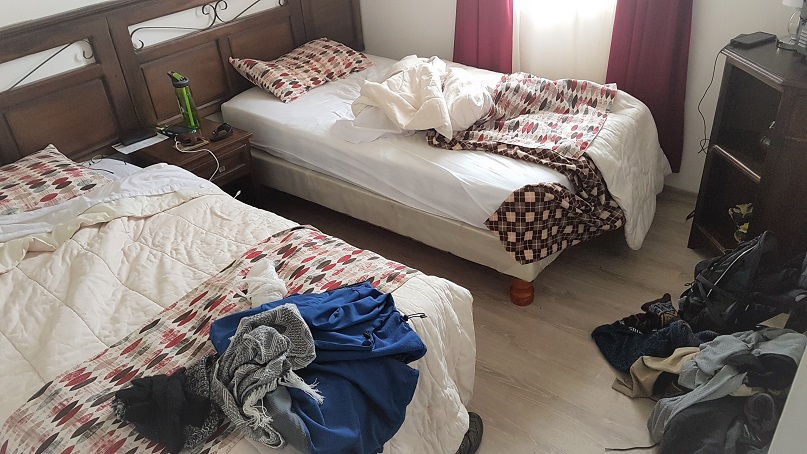
The alarm shatters the silence in the morning after a well-earned sleep from yesterday. We both had a very comfortable sleep at our overnight stay at the Chuquiraqua Lodge & Spa, set into the quiet hinterlands and farmlands 8klms off the highway at 3,336m/ 10,945ft elevation and we are buoyed by the energy we have now inherited. Scott had completely destroyed his bed of course, whereas mine was like a display bed. I’d like to think I am a peaceful person at night. Worried about Scott though 😊. The facilities in our room are wonderful and the little room heater is abuzz. The morning air, we’ll say is brisk .. at best. We are warm and fresh after our hot showers and within minutes we are dressed in our trek gear and backpacks are sorted. We sneak out of the double storey multi-room unit block and walk swiftly across the carpark to the restaurant for breakfast avoiding the wind somehow.
We are greeted by the Manager, Krystie & the European Chef however they are very busy as expected. We sit in the lounge awaiting breakfast call up. The choice of meals is above standard. We are ahead of time so all is good. The German family are already through their breakfast and about to leave as their guide has turned up and we are to place ourselves at another smaller table. We smile and say good morning but don’t intrude any further. It is Easter Sunday today and the German father greets us at our table with a boisterous “Happy Easter” and presents Scott & I with a mini chocolate Easter Egg each, and states with humour, “it’s also a German thing to provide Easter Eggs”. Such a wonderful family group .. we are able to bid farewell properly as they venture to the entrance door after their guide has packed their van. We wave a hearty good bye.
We enjoyed our breakfast and now sit in the lounge wondering when our guide will arrive. Krystie is talking to a gentleman at Reception so can’t intrude. Time is getting away now so I was about to approach Krystie when she advised the gentleman, she was speaking to is now waiting to take you back to the Chaupi Community Village to meet the tour bus. We had been sitting there for about 20mins in full view of them only metres away, so I can’t fathom the delay. We scurry to the van when Krystie calls out to me. She had forgotten to provide the bill for dinner last night. More minutes now taken to clear that up but I knew the dinner was an exclusion in the tour and totally slipped my memory to pay. Breakfast was included in the tour so all good there. What a pressured 10minutes and more time wasted! I wholeheartedly recommend Chuquiraqua Lodge & Spa.
We arrive at the Chaupi Community Village in record time from yesterday. The driver must know we are late now. The tour bus is waiting for us of course. We hurry out of the van knowing the other trekkers are now passing daggers at us. The guide says we are very late and been waiting there for some 20mins. We say “Buenos dias” (good morning) and apologies to the bus but we hear only muffles. What else could we do?
The bus starts up and we do the famous right hand turn again onto the highway .. close our eyes again. Quilotoa is approx. 2.5hrs south of Quito (capital) however we escape the first hour by staying overnight in the Chaupi village region. We now have a 90mins trip to get to Quilotoa Crater Lake but further up the highway we must turn right at the large overpass where we turned left yesterday to Cotopaxi Volcano, to peruse the guide’s home village of Pujili, set at 2,944m/ 9659ft elevation, where there is a large market today. The guide is full abuzz in excitement and passion for us to see his village. We squeeze into a large carpark full of all different size buses once we weave in & out of traffic bedlam. We alight the bus and the guide provides us more detailed instructions where to meet up as the bus will drive to that point a little later. Getting our bearings on where best to head, we are so surprised to see our Las Vegas friend from yesterday alighting from our bus. She was the only one unfortunately from yesterday. She was thrilled also we were present. So embarrassed in not remembering her name.
With that sorted we cross the street into the mire of over active people all scurrying with their purchases of fruits, vegetables, fish, fowl, duck and some things not to mention. So many tourists are already here plus the indigenous people. Scott struggles with the live trade so we venture to the fruit, vegetables and bakery section. The indigenous people just walk through you and never smile or say “Buenos dias”. We find this is normal behaviour of Peruvian and Ecuadorians so far which is so different from my Cambodian & Vietnam experiences where they love tourists and know we bring money to help lift their living standards.
Looking over the market stalls we can see the German family from last night .. too far to get to them but their eldest son passes close by & recognises us. He smiles and says “Hello” … great to see them again. Maybe we will catch them later on. After about 30mins we are first at the meeting point, then the guide turns up. It takes another 20mins before everyone finally arrives … no apologies forthcoming now for the stragglers and you can tell the guide is frustrated. We cross the street and the bus is again underway. We have well over an hour of travel still and much higher elevation too however, it is expected the road is very modern and smooth and the weather is perfect for now.
Some 30minutes later we stop alongside the road out the front of a farmhouse. We are advised what we are about to experience is the actual farm living conditions of an indigenous family. The family greets us with cheering smiles in their indigenous farming costumes but remain silent. We note, the farm animals of alpacas, dogs, cow and sheep and an old crop of corn. Their huts were circular and made of straw thatching with earth floors. The larger hut was the main house and inside there were cages, benches, shelves, cooking utensils hanging off the walls, one very large bed and about 20 guinea pigs free ranging on the floor and taking no notice of us. For some reason they stay within the boundary of the hut which is so unusual for us. Everything is done in this hut for the family.
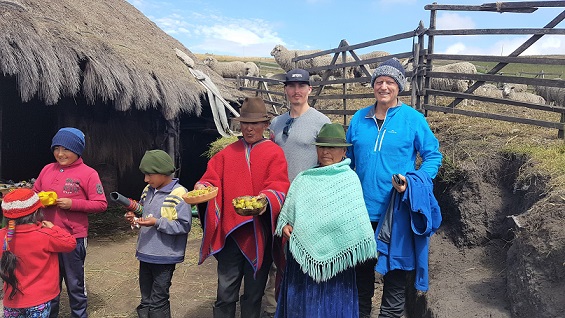
Once outside, the father spoke in his indigenous language and the guide translated for us. He explains times are tough getting the crop harvested and to keep the family together, etc. He asks if photos are taken to offer a small donation. The family get most of their income from tourism now, hence the old corn crop I suppose. Their sons follow us like puppy dogs, watching us closely, circling around us offering all types of tourist bangles, key chains and the like. The girls were more reserved and shyer. I bought some cloth bracelets for my 3 grandchildren back home and donated well to the father directly, and he smiles appreciably. The family all group together like its well-rehearsed and wave us good bye simultaneously.
All aboard again and we all enjoy the much higher mountains, some snow-capped from the view of our windows. The scenery is majestic to say the least. The bus now winds further up steeper hills for the next 45mins and then into a narrower road and under the overhead sign welcoming everyone to Quilotoa; with an elevation of 3,914m/ 12,841ft. The village is small, clean and many buildings and homes are being constructed and/ or refurbished. The walk down to the crater lake is free of charge however, the community imposes a village entrance fee of $2USD/ person that goes towards community improvements so we pass this onto our guide while hopping off the bus. The air hits hard with the icy wind chill especially when the bus was so warm. The guide shows us our restaurant and meeting place for lunch later as we stroll past the many side market shops. We are quick to see the quality of their goods are so much better than what we have seen elsewhere and well-priced.
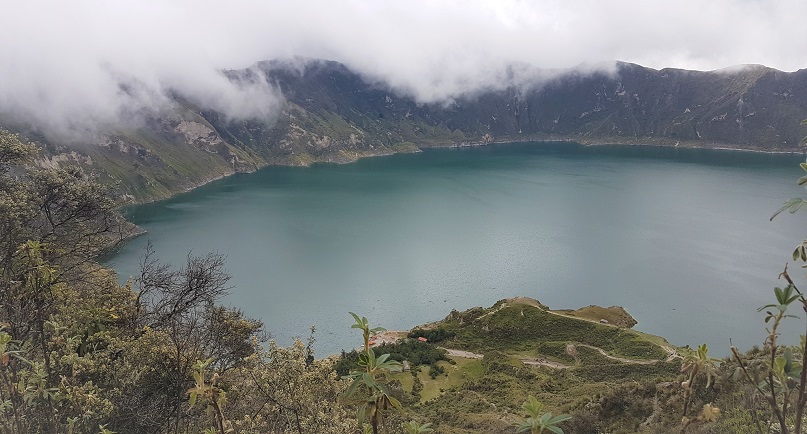
Quilotoa (Spanish Kilo,to,a) is rare in so many ways. Firstly, Quilotoa means ‘Water Filled Caldera’. The village of the same name is located precisely on the crater rim and is now tourism based with quaint hotels and bars built in better, more modern construction than the village area. Not sure about living directly on the edge of an active volcano though. The volcano is the most western in the Andes mountain range and the Caldera itself is 3klms/ 2 miles in diameter at its widest point and now filled with emerald coloured water from minerals present some 250m / 820ft deep. The last eruption was some 739years ago in 1280AD after a dormancy period of some 14,000 years. The eruption was in a catastrophic scale and lava reached the Pacific Ocean, some 200klms away.
From Wikipedia: A Caldera is a large cauldron-like hollow that is formed when a violent eruption of magna, or lava, leaves a gigantic empty chamber underground. The land above drops into this empty chamber and in Quilotoa’s case an inland lake eventuates. A crater, however is almost always a vent for volcanic activity.
We are directed downhill towards an unassuming timber stairwell, some 2m wide between market shops and the guide talks more about being careful with our steps and to say he will talk more when we get to the viewing platform shortly.
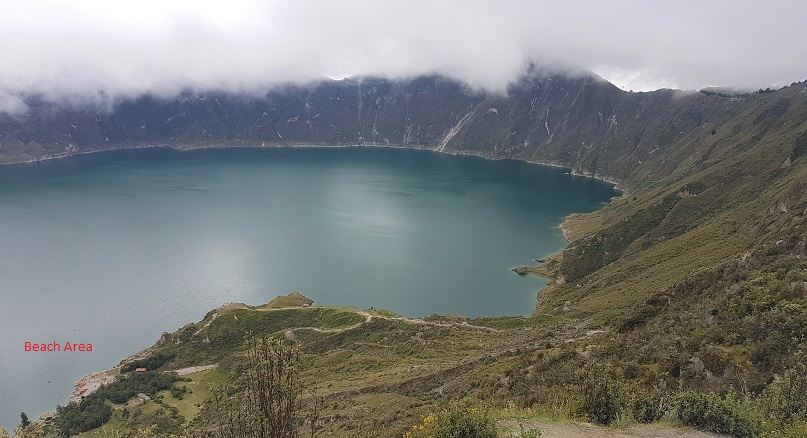
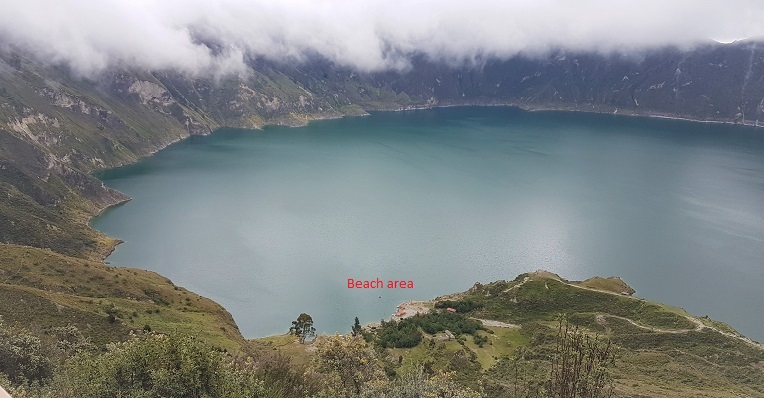
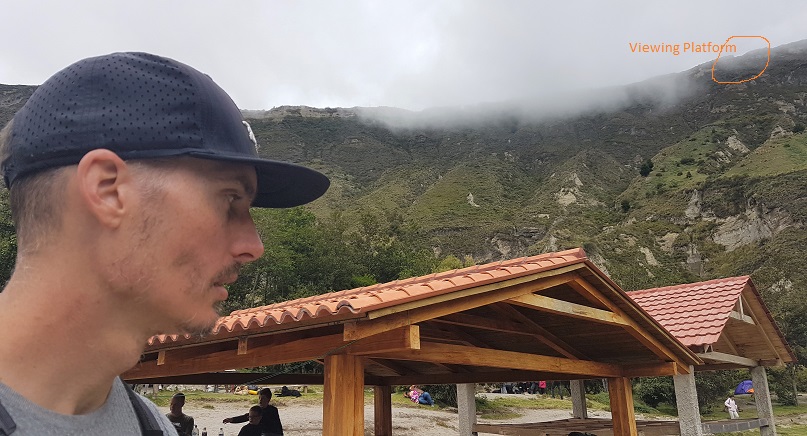
Coming off the 25m long timber stairwell there is a large group of people standing around blocking the area so the guide finds a spare area to the left on the viewing platform. OMG!!!!! What is before us is the most incredible view and we are blessed with a sunny day (no wind at the moment from entering the crater) however, clouds form above. Most of us have overlooked the guide was lecturing us on the crater’s history; such was the view before us. The guide understands this and now repeats his talk, much to our delight. The above historical information was in his talk however, he advises us of the timeframes and stamina needed to walk down & up the crater walk making sure we understand the protocols of sharing the trek route with donkeys and horses. For a cost of $10USD you can hire a donkey/ horse for those that find the trek too tough.
We are left to our own devices now so Scott is super keen as usual and Dad staying with him noting I am much better going downhill. The trek does need concentration with your footsteps for the awkwardness of sands, gravels and rocks with stone walls along its perimeter. Added to this is the close ‘contact’ you have with the numerous donkeys/ horses with their accompanying handlers. Believe me, there is not much room on the trek route and sometimes it is best to climb onto the 600mm high man-made rock walls or them to pass by. Surprisingly, the animals are extremely cautious and avoid the trekkers with precision and care. Really amazing to witness this. Also, when the donkeys need a breather they abruptly turn sideways and partially block the route until they are ready, or their handlers get more vocal. They certainly know when to rest.
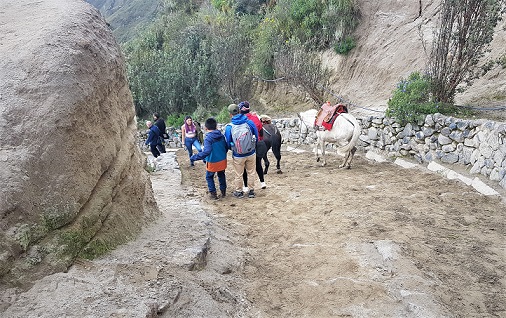
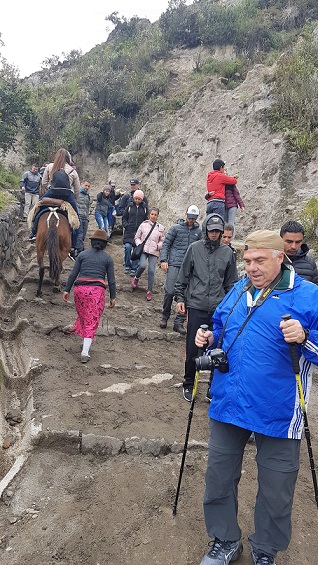
We take our time traversing downwards in a winding pathway of the 280m vertical descent, taking in the varying views of the crater lake. It is a view you could sit for hours soaking it in. I take note of the volumes of people obtaining the assistance of the donkeys/ horses plus the strained faces of the trekkers scrambling up the trek route. Some people are really struggling however, quite a few a far from fit. Some are obese and much older age but nonetheless, everyone is struggling.
We reach the crater lake surface quite comfortably, noting the large amount of donkeys/ horses still ready for hire. This area does allow very basic camping however, you must bring everything to do so (no shops here). One toilet exists too. Walking off the end of the trek route you come to a small sandy beach and a couple of operators hiring out kayaks to venture out to the laguna (Lagoon/ lake). Scott & I secure a kayak for 3,000 $Pesos ($6AUD) noting tourists pay higher. Our guide looks after all our backpacks while most of us head towards the kayaks.
You have the option of swimming in the laguna however it seems to be quite rare at this time of year. The water is almost freezing and I get the intense water shock when I used the paddle (water was inside the handle & leaking out) … My God!! that’s cold running down my sleeve to my upper body. Brrr!! With the shock over I carefully paddled in sync with Scott and we venture out as far as we can reminding ourselves of the timeline required. It was the most incredible feeling being on this magical water and noticing the tiny bubbles of sulphur reaching through the water surface and into the air. The bubbles are too small to notice any smells of sulphur so that’s a relief. We do the largest possible circuit, taking in the scenery and the huge crater walls totally surrounding us.
We notice other horses & donkeys are grazing in their serenity over in the crater’s pastures oblivious to the hundred or so people exploring the crater and its lake at the beach side. Apart from the beach area there is virtually no opportunity to venture out of the kayak due to the sheer vertical walls of the crater. It seems just a few minutes and our paddle was over, and Scott couldn’t believe where the time went. He was really connected with this place, and to me, I was as well but I had other thoughts too, like, if the volcano ‘burped’ it was all over for us, in an instant. Obliteration .. to everything.
Time is upon us and we must now start the winding 280m vertical incline which probably equates to around 1klms of winding pathway, and Scott is certainly ready for food up at the top. I jumped in first and ‘allowed’ Scott to venture up on his own as it would be easy for him to see my progress following him and there are plenty of people about; plus our Guide is walking mostly with me, hence he can enjoy things on his own. Scott is off in a flash .. “see ya Dad”! Gone in a flash!! .. love you son! … as he paces away without another thought.
In adjusting my backpack and taking my first 10 or so steps towards the pathway I look up to see our Las Vegas friend, (so ashamed I can’t remember her name), taking her position on the saddle of a horse and laughing hysterically. She explained and was bewildered how I missed her first attempt just a few seconds ago. She was helped up by the horses’ handler and she rolled straight off the saddle to the other side, hit the sand and rolled down into the small swale some metres away. She dusted herself off, laughed herself silly and climbed back on. It must have hurt too, but she took it so well we all laughed profusely. Her male friend on the bus was already on his horse and he too, joined in. She said looking at the pathway there is no way she could handle the walk up, $10USD well spent she said. Totally forgetting taking photos … arrgh!!!
There is virtually no breeze within the crater and the sun is quite warm now, so it will take good management on the exertion and water replenishment to reach the top. The guide said it could take me 1hr 20mins to reach the top after I advised him of my incline history. The pathway is now quite full with people, donkeys and horses so I must look ahead and behind to avoid collision factors. Several times I had to jump up onto the side rock walls to allow the horses and mules unobstruction. These times were a great opportunity for respite which was gratefully received. It was strenuous at times trying to gain footholds in the sand which was most of the way. The photos don’t accurately show the strength required to get to the top but of course with little steps you reach the summit in good form. Before leaving the crater, we arrive at the viewing platform again & take the last look below and beyond to create a living photo in our memory banks, such a sight to behold with different outcomes with the cloud cover and then pure sunlight in between. My phone confirmed I did the trek up in 1hr 18mins so that was a great result.
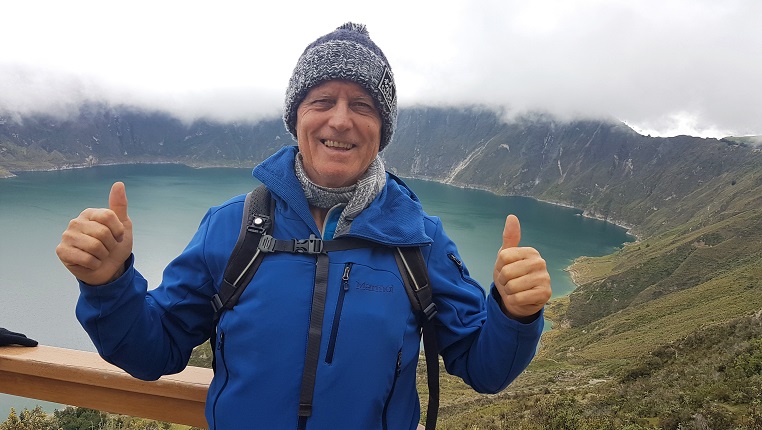
Reaching the top of the timber staircase Scott was waiting patiently and full of congrats for his Dad completing the trek however, he was bitterly chilled as he explains they had a complete cloud come through the village which resembled a thick fog with the temperature plummeting. It lasted for some 10minutes then disappeared as quickly as it came. Being on the viewing platform at the time the cloud effect went totally unnoticed. Passing the small merchandise shops and to the restaurant we find the inside is very hot and in full occupancy so it takes us a while to gain two seats and to be served some well-earned food; soup first. Within minutes of placing our cutlery down we are ushered out to the bus for the return journey. Scott rushes out to purchase a beanie he was looking at prior and he was so pleased he found enough time to do so. It was the best quality beanie he has ever worn and I do consider him an expert on this. He has more than several.
We were unaware at the time that you can do “The Quilatoa Rim Loop Hike” also free of charge that takes you around the complete rim of the crater. Scott & I would have loved to have done this as well but obviously that would be another day we did not have. The Rim Hike takes some 4-5hrs and is very rugged for 8-10klms and provides a continuous view of the crater, lake below and the hinterland outside of the crater. It is noted it is best to do the trek, counter clockwise so that you do the higher inclines when you are fresher. The highest rim part is at 3,915m/ 12,845ft located on the SE side. For this trek you must take a lot of water, snacks and factor in all types of weather as you can have the 4 seasons in one day. Take extreme care and let people know you are on this trek in case something goes astray. Fitness and common sense are paramount. No doubt the views would be magnificent.
The return bus journey was much quieter with a few trekkers catching some sleep plus the guide is sitting with the driver for a while. We know we have about 2.5hrs of normal driving to get to Quito but we are advised to allow another 30-40mins for peak hour closer to the city. Looking at the weather I believe we left exactly at the right time with darkening clouds following us. The sun is now blocked out. I am not that relaxed due to the bus speed and the steep inclines of the mountain road which is wet and appears to be very slippery. Not a good feeling at all.
A little later our guide steps out of his front seat and speaks to me advising the bus driver will be dropping us off at the same place we joined the trek yesterday morning in the city. I said that is what we were told originally so all is good with only a few city blocks to walk back to our hotel, Hump Day Hostel. Within seconds of discussing this with us, the guide says “Bueons Tardes, travel safe”, the bus stops and the guide quickly hops off, now that we have reached his village of Pujili. No-one expected that sudden departure.
Getting back onto the highway the food places are all waving their flags vigorously to notify they are open and wishing travellers to stop. The only stopping we were doing was to refill the bus with diesel. The service station employs several people to do the pump operation and when it is busy, they are holding huge bundles of cash by not getting back into the office. The law here states all persons must alight from the bus while it is being fuelled so we are all ushered to the boundary some 3m from the bus. So much for full safety being that short of distance. We can’t believe how cold it had become and can’t wait to get back into our warm bus. We have at least another hour to go and crawling along.
Back onto the bus and now it starts to rain. You can almost set your watch to rain here; such is the time of the season. Darkness is well upon us and at 6.30pm we stop at a section of Quito we have not seen before. No people around but plenty of flashing signs indicating numerous bars and nightclubs. Everyone says hurried good byes and alights except Scott & myself. Several minutes transpire when the bus driver in broken English says quite roughly “get off bus!!”. I tried to enforce we are to be dropped off at our set point in the Historical Centre and not here; wherever this is. He rings someone on his mobile and hands me it to talk to someone else. The person insists we must get off the bus and it is not their problem due to being another company. Stating my obvious disgust, we depart the bus into the now pouring rain and hurry into an open area of the closest tavern.
We are immediately greeted by 2 young gorgeous ladies working the front area of the bar enticing us for drinks. Scott & I are not as angry now, seeing we have great looking company .. typical males .. I know! My phone is very low on available data so one of ladies offers me free WiFi so I can see where we are using Google Maps. We appear to be in the night party area some 10klms away from the Historical Centre and our hostel. Both of us aren’t keen to stay in this night area so it takes about 10mins or more before we see a taxi or two and I physically had to rope one down to get the driver’s attention. Upon opening the taxi door, we wave and smile at the young lady and wish her well. She reciprocates accordingly. After a bit of broken English, the taxi driver works out where have to go. Fingers crossed. Luckily, I took a phone screenshot of the map prior.
Again, the Historical Centre streets are blocked off still for Easter so we had to move swiftly for quite a few blocks in the drizzle to get to the hostel and on the way, we are wondering where we can have dinner. Everything looks deserted and no one around. With absolute huge relief our favourite eatery, next door to the hostel is open. Bonus! We enter and order food first before even considering entering the hostel. We greet the lady like a family member we have not seen for ages (operates this little shop totally on her own). With glorious food again, we depart and enter the hostel with another warm greeting and straight to our room for hot showers and well-earned sleep. No fuss; “buenas noches” .. good night.
Late tomorrow, we head to Santiago Chile, so I’ll leave that day and others to my next blog. Many thanks for your time and in reading my blogs and feel free to leave any comments below. I trust you may feel the magic of exploring the volcanoes. A whole different level of trekking that can be addictive. Reflecting upon the treks we did recently we went near the Everest Base Camp altitude of 5,380m/ 17,600ft which trekkers fly into Lukla Airport at 2,860m/ 9,412ft. Quito & Cusco airports were higher at 3,400m and Rainbow Mountain (Peru) was at 5,031m & Cotopaxi Volcano Glacier (Ecuador) height, not the top, was at 5,000m. One off the hardest thing was my missing GoPro so not enough pictures and videos taken.
 BH Life Travels