Whitsunday Crocodile Safari
This is my last Airlie Beach blog so I’m hoping you will like this nature blog. From my last blog I had a day in between my wonderful Camira Sailing Tour of the Whitsunday Island and starting the surprising crocodile safari. I booked my tours through Sailing Whitsundays .. https://sailing-whitsundays.com/ located next to Mikas Bar & Restaurant in the main street all in the one session and my programming worked superbly. The cost of the all-weather safari-style excursion was all inclusive at $150/ person with pickup & drop off at your respective resort, an Australian Bush morning/ afternoon tea of a billy tea & damper with local honey & Cane Sugar Syrup plus a full bbq lunch & salads & afternoon tea. https://crocodilesafari.com.au is their website.
Our bus driver, Steve Watson promptly picked me up at the bottom of my steep hill at my Club Wyndham Resort at 8.25am & again, I am the first pickup. He advised we do not have a full passenger list for today’s safari so not that many to pick up however, it did take the full 30mins to complete this task through Airlie & outer Airlie. I believe the safari can take up to 30people.
My fellow safari crew were a young family with a baby, a Townsville man in his 30s with his visiting parents from the Netherlands who both don’t speak English & a married couple in their 60s. The Netherland couple were virtually silent and managed a few smiles & lots of head nodding from their son’s translations.
After the pickups were completed, we headed to the township of Proserpine, some 25klms away to turn left into Glen Isla Rd & then into a signed private property and a paddock gravel road to a large gravel clearing with an enormous shade sail rotunda type roof structure & a few sheds. The rotunda was fitted out with a permanent bbq and serving counter bench, several steel tables and bench seats.
Unbeknown to us at the time, Steve is the Owner/ Operator of this safari tour and has for a very long time and is now hands on, due to limited staff available to him since COVID. He gave us a quick summary of the safari’s history, along with himself and the workings of the operation and what will be expected of us in maintaining our own safety in addition to the safety he will provide. He then explains the sheds behind us with the equipment shed having the recorded flood levels placed on its roller door. Cyclone Debbie in 2017 was by far the highest flood level reading and that was a very damaging cyclone to hit the region and rated a Category 4 (Severe) with wind speeds of 215klms/hr. It was the most costly to hit the region and with 14 lives lost. Come 2023, the region is just showing very good signs of recovery. He is yet to post the recent January 2023 ‘flash’ flood level on the door and that was above the lower markers. The smallest building to the right is the toilet but not the usual domestic one he stated, but a ‘drop’ toilet & if you really need to go, then accept the ‘vibe’ of it. Lol!!!


When Steve finished his talk, he instructed his 2 assistants (Steve & Jim) to place the barge boat into the Proserpine River some 30m away & said that is worth a look. With the other customers still asking questions to Steve I raced towards the river to catch a brief glimpse of the 2 assistants swinging the tractor-driven crane rig with the barge attached into the river below. They had obviously had this all prepared earlier and I was very lucky to get a glimpse of this faster than usual method. I was watching the man in the barge hoping he had a tight grip on the barge. Not a place to fall out of a boat. The man in his 30s was very pleased I showed him my photo of this as he really wanted to see how it was done.
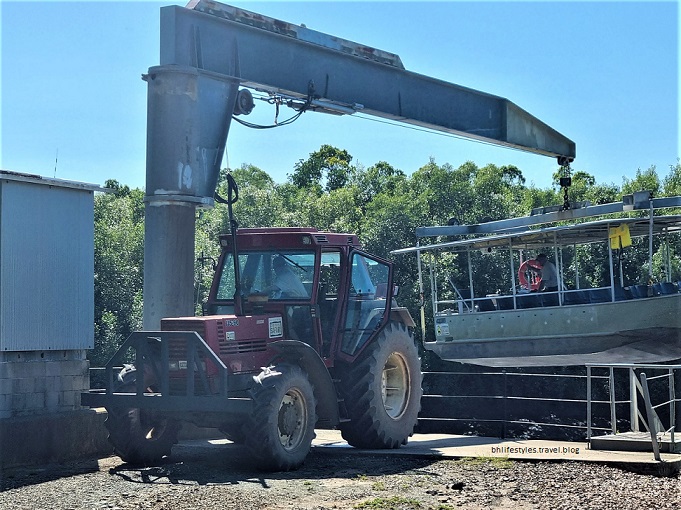
We were all ready to board now and it was a concentrated effort going down the gangplank steps so as not to slip or lose balance entering the boat. The lady with the baby was extra careful of course. Steve, again confirmed the safari is not a fauna park or farm & sightings cannot be guaranteed however 99.8% sightings have been achieved in over 6,000 tours over 20yrs of operation. Being a safari that he has operated for decades he does not feed the crocodiles to gain visibility or to change their habitat or eating habits. This area is a true environment for crocodiles and their breeding. This area of the river has been used at various times by accredited researchers & scientists in reviewing water quality, sightings, breeding nests, eggs, etc to help manage this eco-system & preserve this Freshwater Crocodile habitation & his operation has assisted greatly in their research.
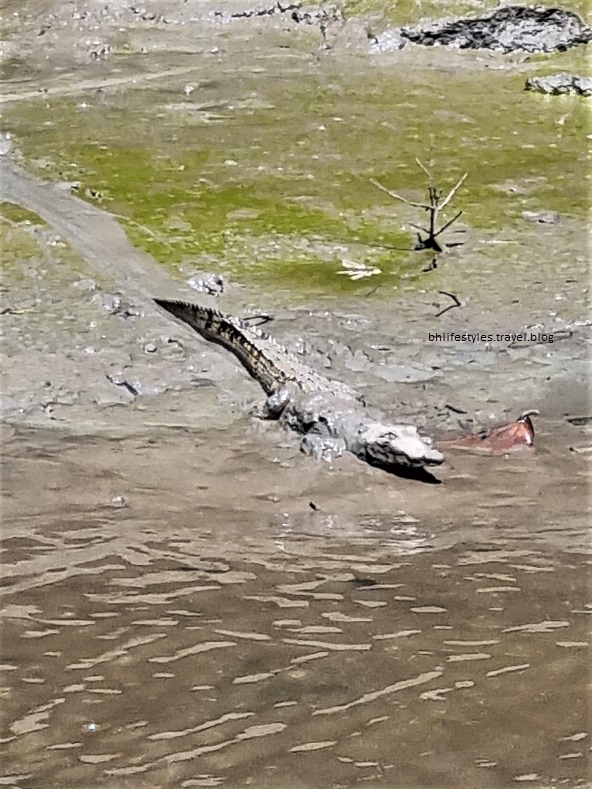
This river is for Freshwater Crocodiles whereas the Saltwater Crocodiles are elsewhere and are much larger than the ‘Freshies’. You can tell which ones they are by the head shape and teeth. The Freshwater Croc has a sharper shape snout and aligned teeth whereas the Saltwater Croc has a broader snout & un up & down jaw line with irregular jutting teeth. Freshies can grow to a rare 3m but 2.5m is the more common large adult size. They are not ‘man-eaters’ and feed mainly on frogs, lizards, turtles, bats, birds & small mammals. Male ‘Salties’ grow to 7m but commonly 5m & the females around 4m mark. They begin nesting at 12yrs of age & live 70-100yrs.
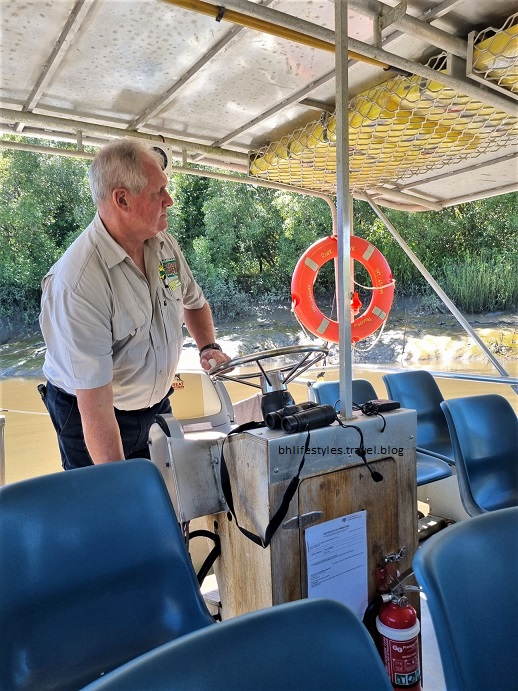
Steve, with his microphone and pa system setup on the boat was a huge plus for us in order to clearly hear his commentary. He rattled off a few names of the crocodiles he has identified over the years and where some of their respective nests are, albeit they are hard to see through the overgrowth. These nests can harbour around 50eggs and incubation takes around 65-110days. The female usually guards the nest until hatching time. The incubation temperature determines the sex of the crocodile with the temp range 31-32°C producing males. With higher or lower temps producing females. Pigs & goannas eat the eggs & floods destroy the nests and these factors create an alarming statistic where less than half of eggs laid will hatch & of those hatchlings that live, less than 1% survive to adulthood. The hatchlings and young crocodiles also become food for other animals, and crocodiles can be cannibalistic. Around 50% of the hatchlings will die within their 1st year. Hatchlings are about 70grams in weight & 25-30cm long & maybe protected within a creche for up to 5weeks in the water by their mother.

Steve then explains how to determine the true sex of the crocodile by rolling it over on its back and then using your hand to invade its private area & that will provide you the evidence. Steve stated we will not be doing that today or anytime in the future. LOL!!!
Crocodiles are a rare type of reptile in that they are the only ones with a 4 chambered heart like a human whereas other reptilians have 3 chambered hearts. Unlike us they can slow their heart rate to an amazing level, some 2-3 beats per minute thereby allowing them to be submerged for more than 4hours. They also have glands at the back of their fleshy tongues to exude built up salt. They also have a 3rd eyelid that enables them to see & swim at the same time. The Freshie Croc has the longest tail and is 49.5% of its total body length. When you see only the head of the crocodile in the water you can determine its total length as the head represents 1/7th of its length.
Crocodiles seek to keep their temperature range between 30-33°C so they will use the water, sun & shade to do this. The larger the crocodile the less tolerant they are in anaerobic activity where they build up excessive amounts of acid into their blood. Whilst crocodiles can withstand very high levels of blood acidity than most animals it can prove to be fatal. That’s probably why you saw Steve Irwin (Crocodile Hunter) yell ‘Crikey’ and lay on top of the crocodile when capturing them. To keep them calm. He can have that!!!!

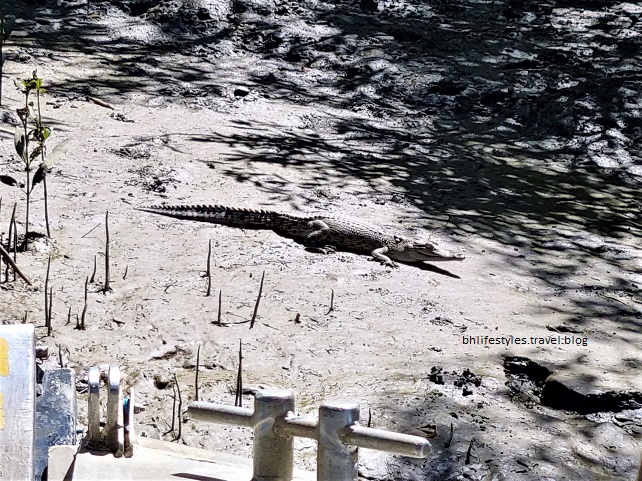
Steve took us up the river and explained how the river is constantly changing with the tidal forces, floods, and bank erosion with the sandy loam alluvial soil. Crocodiles clambering up the banks to their nests, etc doesn’t help either. You have to marvel at Steve’s brilliant observation ability by pointing out using a laser to show you the smaller crocodiles sunbaking on the banks in true camouflage. He was picking them out over 20-30m away and we had to inch closer so that we would not disturb them to get a closer look. Very hard to pick them out and you must really focus. The river water varies from 4m to 25m in width and usually about 4m deep in most places. Some of the young crocs are quite nervous and portray different mannerisms when we approach. Open mouth, sinking or raising their stomach from the bank which can be assumed as a threat or non-threat to scurrying off either up the bank or into the water.
As we now progress to going down the river Steve points out his named female crocs and where their nests lay. He knows their names by their markings, scars or lost scutes (spikes) on their tail, etc. After seeing quite a few young crocs, we encountered, albeit briefly a protruding head of ‘Dorothy’ a mother submerging at the bank edge close by to her nest. Her head appears to be 50cm long, therefore 3.5m in total body length. She is not impressed with us and not recognising Steve (kidding) she submerges fully and only resumes her position once we provided a safe distance. Crocodiles rarely provide you with the perfect photo shot so you have to take what you can get & remember to keep your whole body (arms) within the boat.


Alighting from the boat and reaching the top of the bank to safety, Steve shows me how much the river changes in that the original jetty once used, is some 100m to the East from the other side of the river bank. That is a lot of river route changes. In time, the erosion will reach where the tractor is sited with the crane. How is the lost land to the owner is compensated? Steve leases his safari grounds off the land owner, so Steve cannot see how this would be done. He may have to seek approval to put in place a revetment wall at some point or the owner to do so to eliminate or restrict the major erosion taking place every time it rains, let alone floods & king tides.

I would imagine you would see a lot more crocodile activity around dawn and into the warming sun of each day, and seeing its mid-day, the activity is limited. Seeing plenty of the muddy river bank, full of holes of numerous crocodile food mud crabs and crocodile slipways & its foliage/ mangroves it was time to return to the pontoon steps and alight for a true Aussie bbq lunch with steak, sausages, chicken, onions, breads, salads, etc superbly cooked by Jim. If you wanted a soft drink, you could purchase these out of the esky. I settled for a Ginger Beer and that hit the spot on this high temp, high humidity day.
With the lunch being completed we were urged to join the wagon-train of carriages now that the tractor has been connected, for we are going out to the Goorganga Plains Wetlands that we first came through on the bus road, but this time off-road. Passing by and getting a close look at a gathering of kangaroos and the large male watching us closely was a thrill for the Norwegian parents. Surely, the roos know that there are crocodiles not far from them? Apparently, the crocs stay close to the river however, Steve starts a story when he came down while the plains were still in flood sometime ago where he saw a group of cows in a circle in above-knee water which seemed quite odd. He took his tinny close to them to find out some 15m away was a 4m+ crocodile in waiting which confirmed the cow’s weird behaviour. He phoned the farmer who soon came down in another boat to help relocate the cows. A close call I’d say.
Steve stops the tractor and starts to talk about the nearby tree and some of the bushes surrounding it and some of their medicinal purposes they have been for the aboriginal & now the medical fraternity in addressing pain relief, mosquito bites and the like. He needed a volunteer to wash his hands after showing us the dye colour of the bush fruit berries. Very strong reddish dye.


Meandering at tractor speed we encroach upon a billabong full of birdlife. Here Steve points out all the various types of birds and which ones are migratory. So much birdlife!! Steve’s knowledge is amazing and there is just too much information to take in. Listening intently to his commentary took me away from taking more photos but you can never complain when you are fully immersed in nature, but my apologies to the readers. I was slack! I can’t even remember what breeds of birds and of which countries they had come from … too many to name.
Steve shows us where the flood levels reached on this plain and what lies over at the far distant mountain range to the West and how this affects the township of Proserpine and the river. This area is very accustomed to heavy rain and flash flooding. I don’t think I could get accustomed to the crocodiles. Fact!
After doing the lap of the plains we returned to see more kangaroos and the gravel bivouac area to an amazing aroma. Jim had cooked us a damper and more billy tea, just like we were on a bush camp. Impatiently, I had to wait for the pleasantries of another editorial from Steve & to wash our hands before I could dive into the 2 types of dampers, a fruit raisin one and the plain damper cooked out of cast iron pots. Yummo!!! Well done, Jim!! The cane sugar syrup on the damper was superb and brought back many childhood memories. Steve also had a small portion of Vegemite he was able to ‘con’ the Netherlands parents into trying. He repeated the need for a very thin spread of Vegemite to the damper, but the mother rejected the taste immediately, but the father didn’t mind it. Steve, again stated they had too thick of spread on the bread. We all agreed it is an acquired taste.


Using a very small portion of left over bbq sausage mince, Steve threw a piece into the air when suddenly, a black shadow appeared at speed and took the mince, mid-air. So fast!!! From memory, I believe Steve called it a Swiftlet. It is a rare bird that can eat whilst flying whereas most birds have to land to feed. He throws another piece up and we still can’t imagine the speed & accuracy of this bird. Truly amazing!! No chance of a photo of this!!
With things wrapping up we were ushered back in the bus after we all personally thanked them for a great day & for me to be dropped off at the main street of Airlie for my repeated lagoon swim and beer afterwards. My reward!
Coming into the township of Proserpine again, Steve talked about the cane carriages & the mini trains to transport the sugar cane from the expansive fields to the sugar mill some kilometres away, stacked along the tracks parallel to the roadway. This region in Nth Queensland is the major cane field area & mass producer of sugar by far in Australia. Bundaberg, further South is another major sugar cane area and they have a famous Bundaberg Rum distillery which produces a huge volume of rum and one of the best ginger beers. Some of their rum bottles become valuable collector items and at times they create limited rum offers.

I’ll end this blog here and appreciate you all for taking the time to reading my travel blogs. My next blog will be returning to my ‘Jungle Tour’ with my great friend, Chung out of Dalat, Vietnam who will take me on a 4-day into deep Vietnam. Take care and enjoy life.
I don’t receive any commissions for promoting or mentioning companies in my blogs as I rather speak honestly on my experiences with them. I will never be compromised.
 BH Life Travels