My Europe Tour 2025 – Blog #5 – Rome City

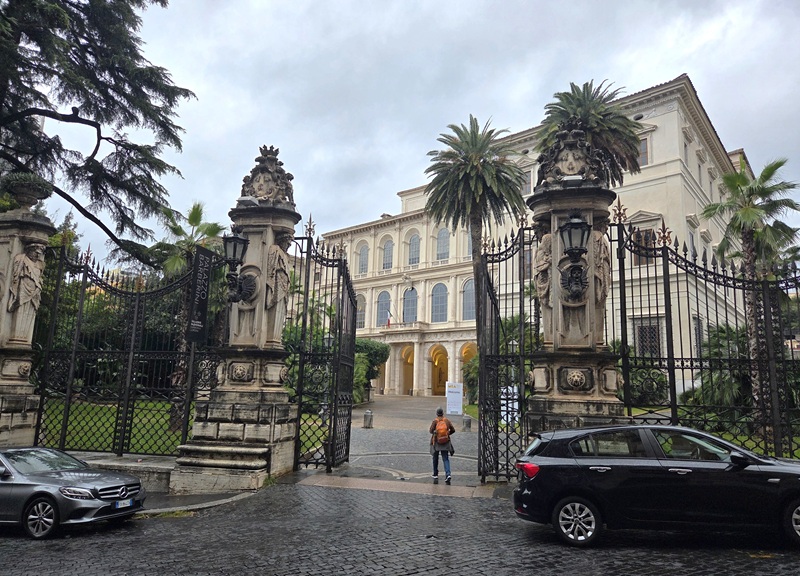
Day 4 5/10/25 Rome City Walking Tour. My last full day in Rome. Scott is our guide for the walking tour & we finally found him at the City Wonders Piazza di Spagna, 00187 Roma RM without the blue shirt as prescribed so you always have to keep a look out for your guide. I was starting to get worried due to the last City Wonders debacle I described in my last blog. He was very pleasant & had no pushed time attitude. Scott is an American but has lived here for a decade or more & has a generational connection to Rome & has stayed here since retracing his family history. On my way to the meeting place & steps, I walked the same streets as before & noticed an impressive building with huge stone walls & metal gates. I was previously in a rush but today I noticed it was the National Museum but not sure when I can return for a viewing. Maybe next time visiting Rome. LOL!

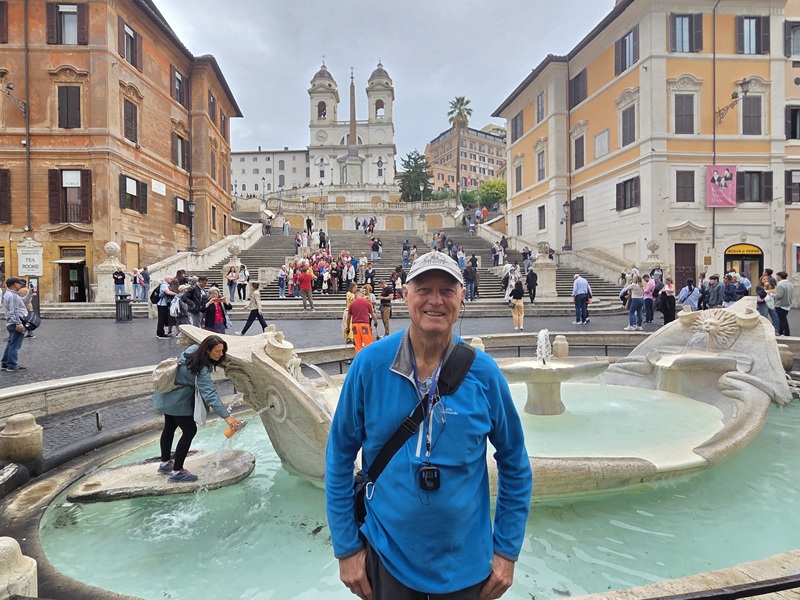
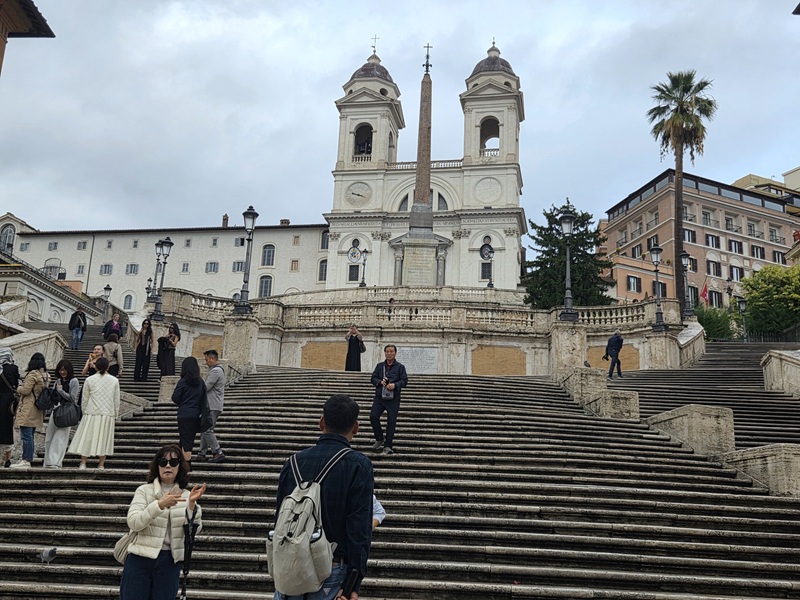
Today (my last Rome day), we are going to see the famous Trevi Fountain, Spanish Steps & Pantheon Walking Tour, however we will finish the tour at Piazza Navona some klms away but after that we will have plenty of free time to do our own thing. Now that everyone has arrived Scott shows us the Spanish Steps that was right behind us in the Piazza di Spagna all this time. Of course, there are no historical signage to identify this to tourists so I’m not to blame. I saw this structure the day before when heading to my meeting point for the Positano tour plus the central fountain. These steps are called the Spanish Steps however above these steps is a building with a mixture of French & Spanish architecture and with that ongoing conflict the Spanish eventually won. This is quite a meeting place for tourists & locals; however, the police can move you on if you sit on the steps, for it is forbidden.
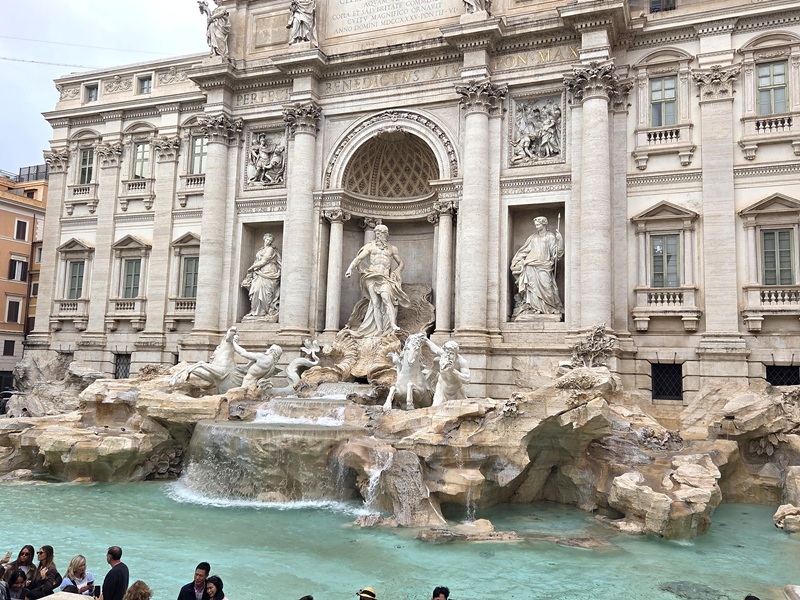
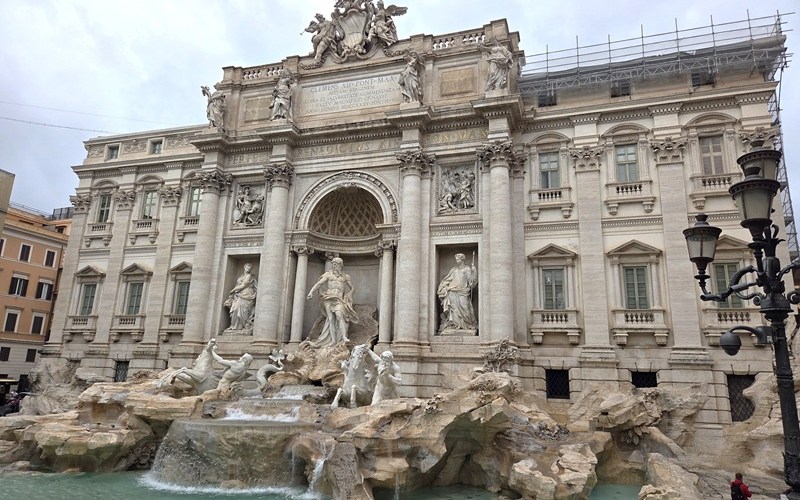
Scott has us now walking towards the famous Trevi Fountain & I’m really happy we are doing so because the courtyard area is filled to the brim with tourists later in the morning & into the afternoon & it is not a pleasant experience. Sharyn at my cousin’s Wobbly Chook Brewing Company back home said you have to see this amazing, sculptured fountain. So, Sharyn, here I am, & throwing a coin over my left shoulder like many thousands before me. Apparently, the fountain coins are removed weekly & approximately €22,000 is gained. The coin throwing is a legend that it will make you come back to Rome another time.
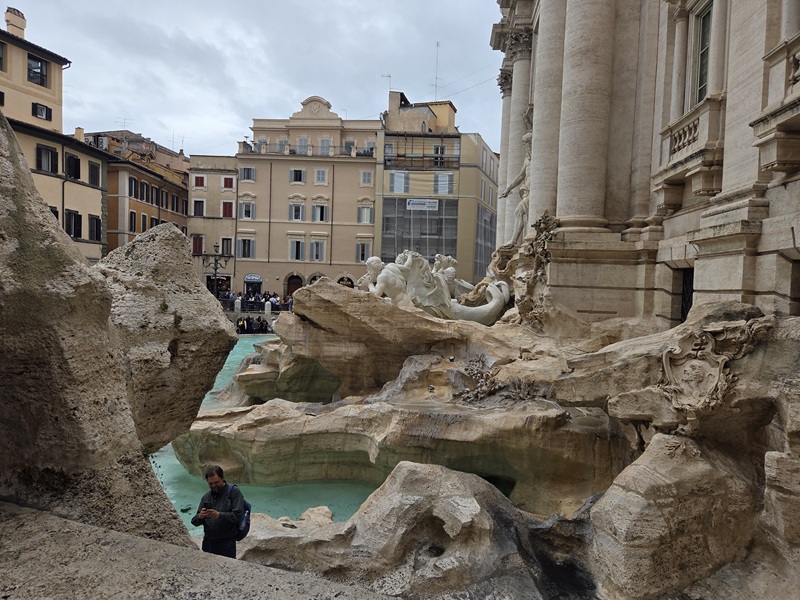
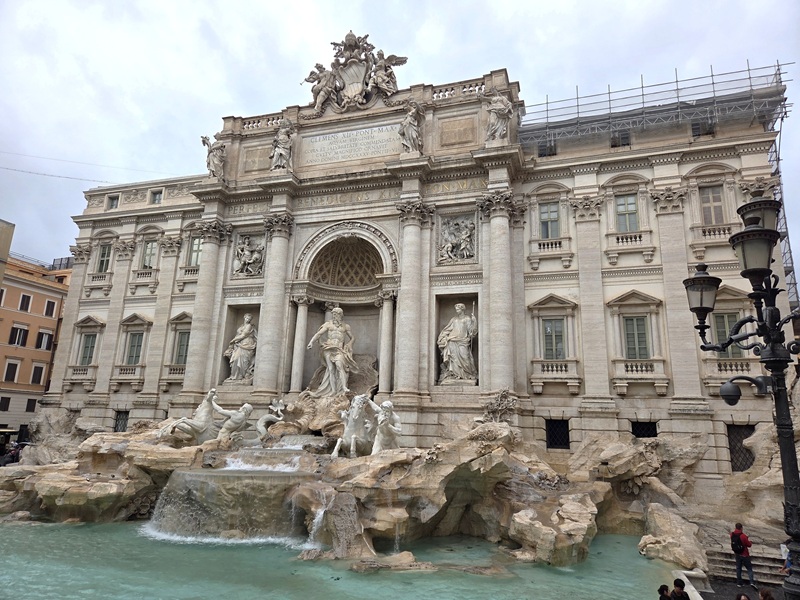
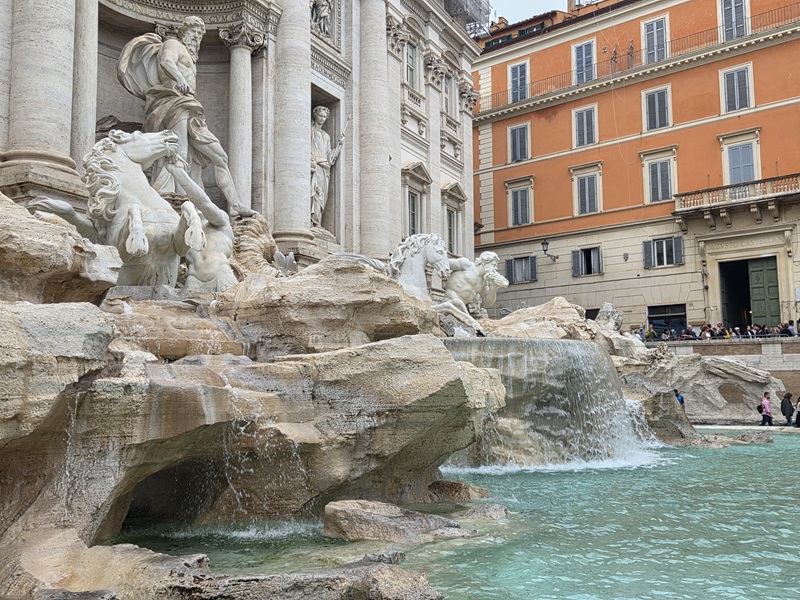
The Trevi Fountain is something to behold. The details of sculptures, the size of the fountain. It is a full building width & the high volume of water comes from the aqueduct system below the ground. The God in the centre is Neptune. The crowd must keep shuffling along & when access is obtained you must get to the fountain edge asap (no standing at the top steps) or the ‘fountain police’ will blow their whistles in disgust. Definitely, no hands or feet in the water. Criminal offence. With our ongoing movement, we were soon out of the enclosure & Scott starts showing us his hidden Rome with amazing glass roof arcades of luxury shops, polished marble columns & ancient treasures.

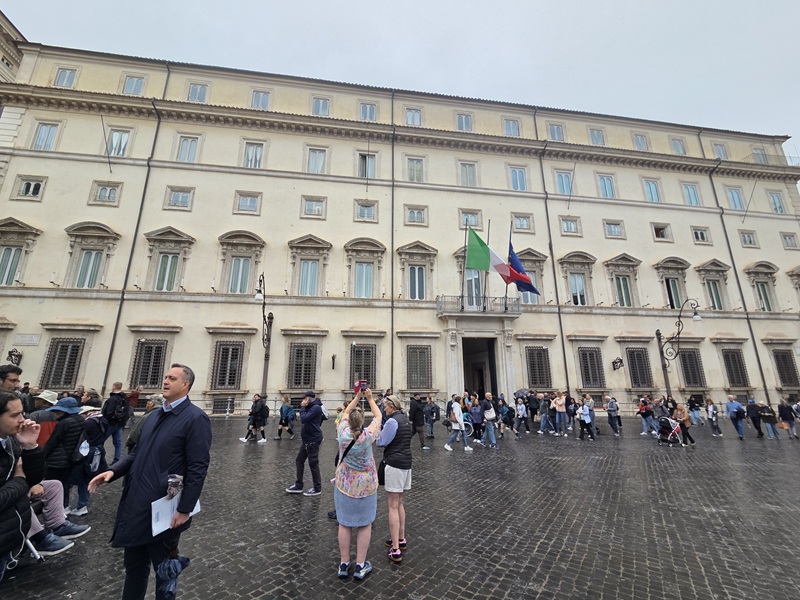
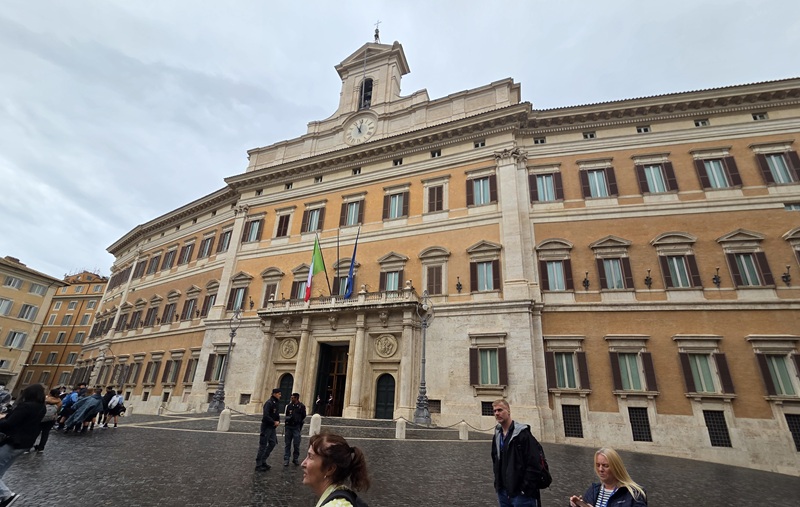
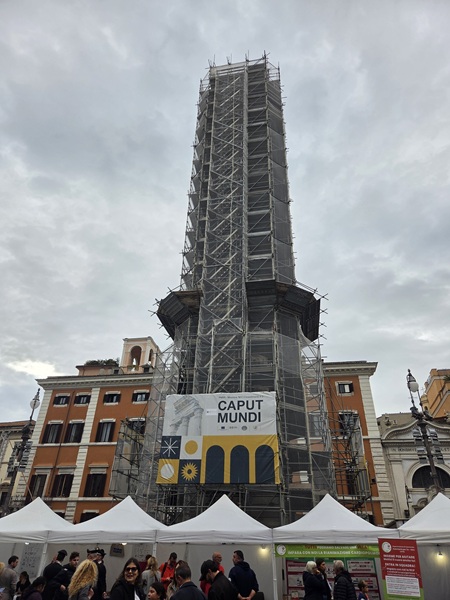
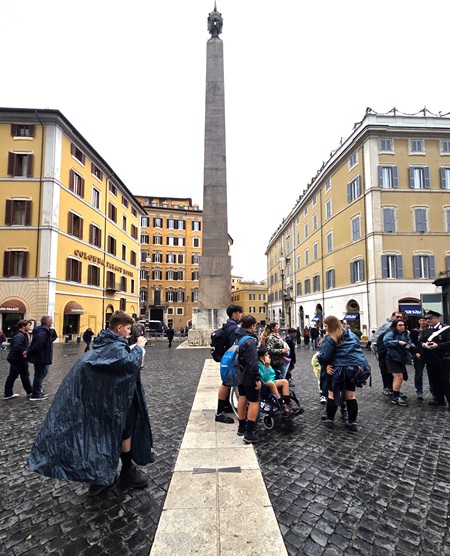
Unfortunately, one of the major things I wanted to see was the Marcus Arillus Statue, but this was fully enclosed with scaffolding (photo 2 below) to undertake the necessary refurbishment. Another thing to revisit Rome. Hope you enjoyed the scaffolding photo? The next photo Scott said was Italy’s White House (3rd photo). This is where President Meloni resides & carries out her duties. It was a very unassuming building & one I would have walked straight past. The next building in this very large courtyard was the more impressive Senate Building (4th photo) where laws are made.
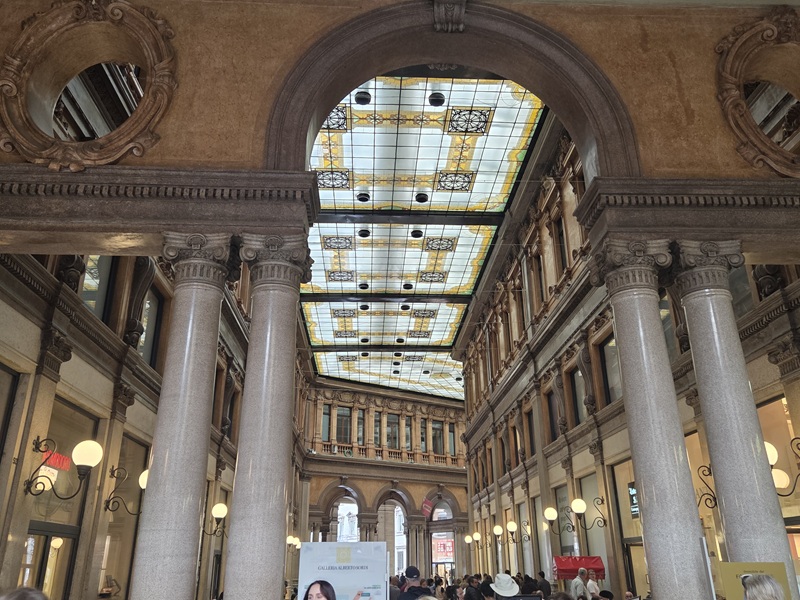
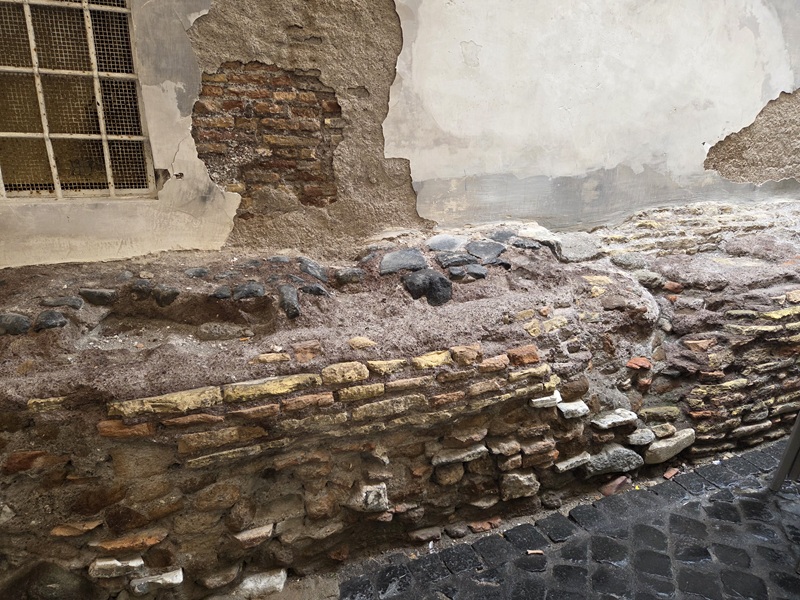
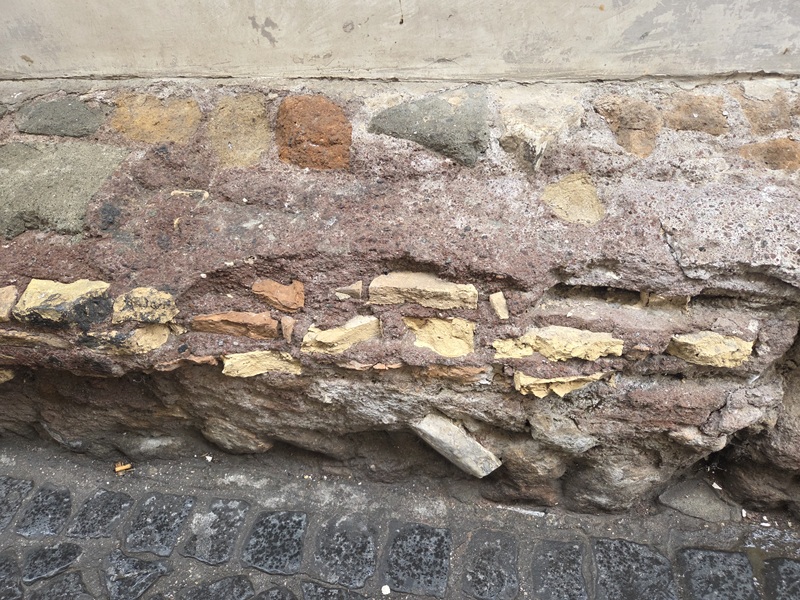
The photo of stones, bricks & different shades of mortar are the original footing/ foundations of the Roman era & they remain in perfect condition to this day. There are several of these exposed footings for viewing & again the public would just walk past this history. Throughout roughly 2,000years of history, no-one could replicate this concrete mortar, for the recipe was lost early until modern day technology scrutinised extensively the granules & found the missing ingredient was the grey & white pumice ash from the eruption of Mt Vesuvius in 79AD. The setting mixture is incredibly strong & can withstand the elements of weather.
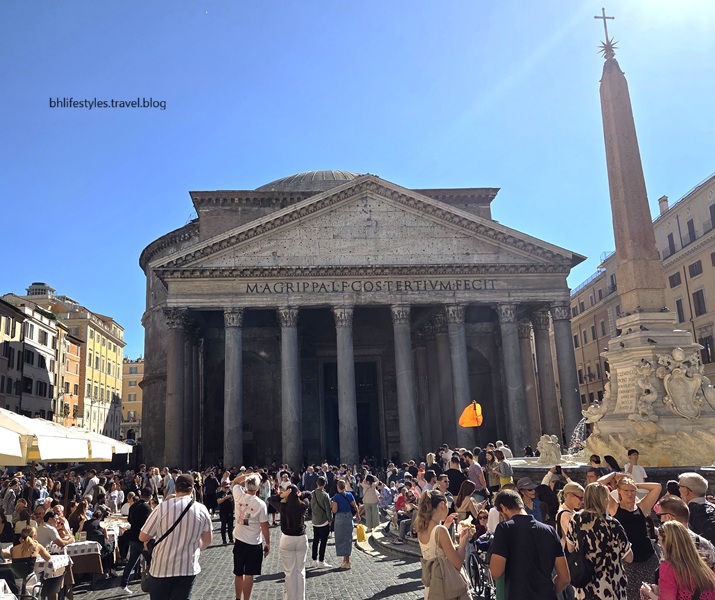
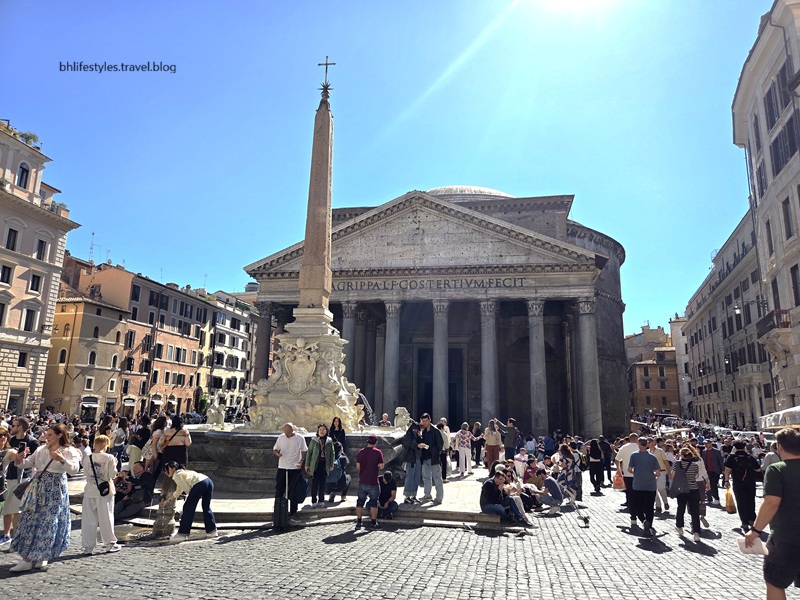
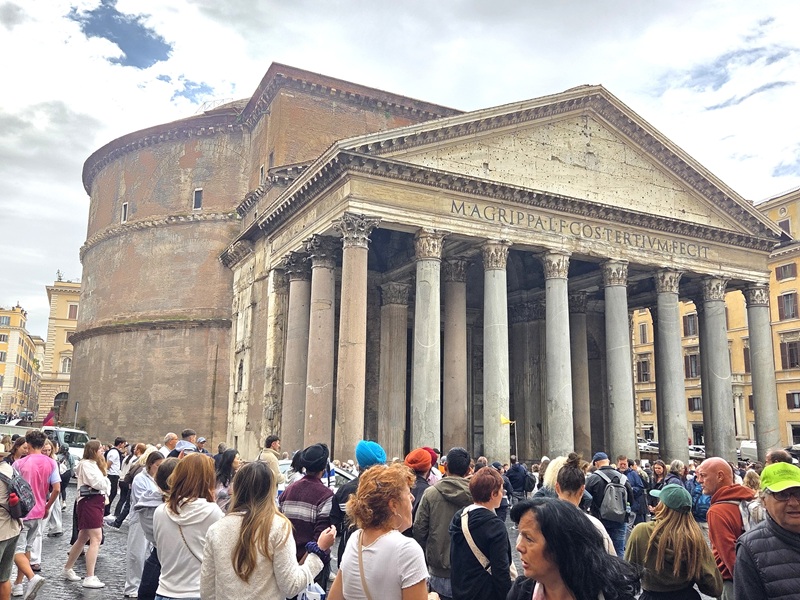
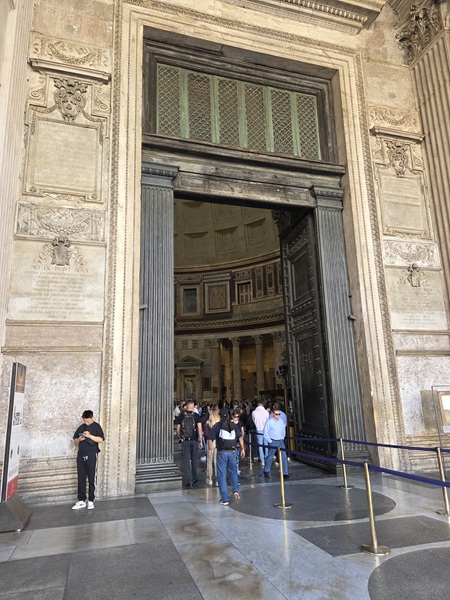
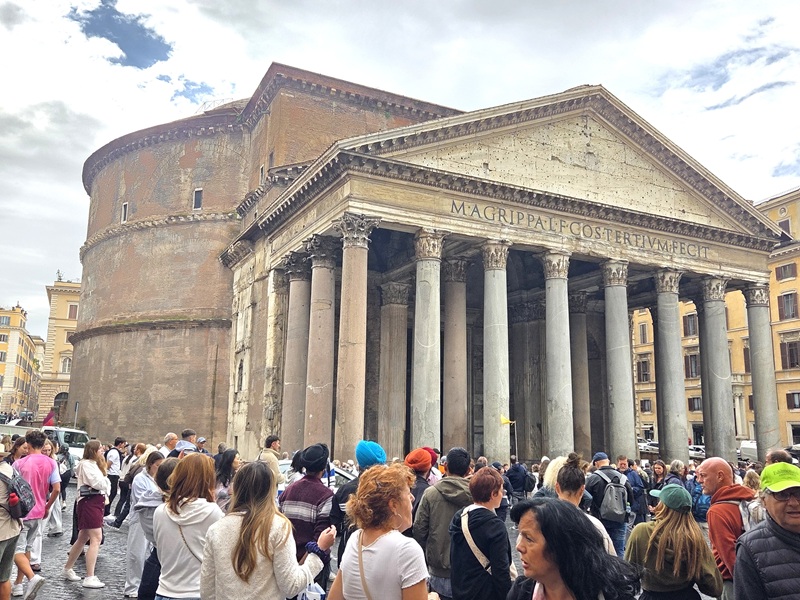
Following on from these footings & turning a few corners we come across the incredible Pantheon with its amazingly strong frontage of 16 hand-carved stone columns. Each of these columns weigh 60tons & were hand crafted in Egypt & shipped over (don’t know how they did that). They used up to twelve elephants to erect each column. With this being a Walking Tour there is no admission today to enter The Pantheon but after the tour you can line up with the public & buy the tickets unless you paid for entrance ticket previously online, etc. I saw the interior of The Pantheon on the 1st day of my arrival in Rome, so you would have to go back to my 2nd blog to see the photos & details.

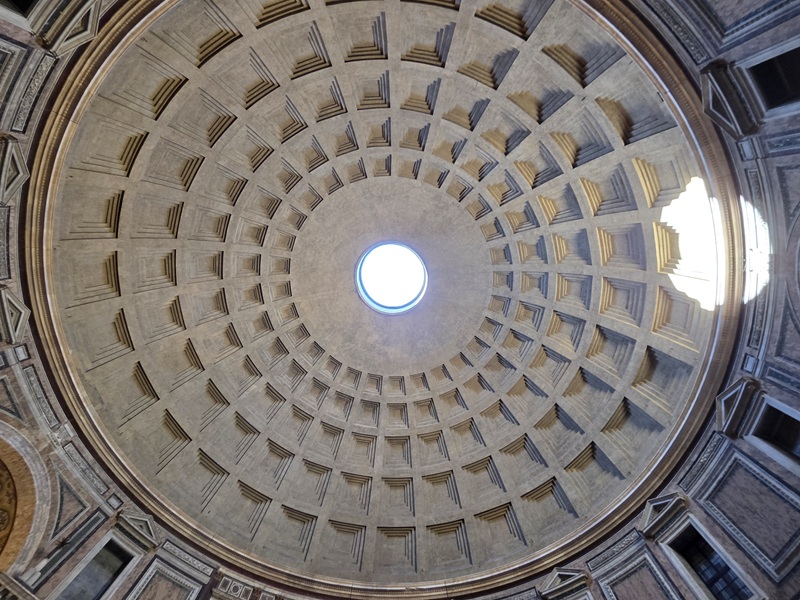
Standing outside you can see the shape of the world’s largest concrete dome of that type above us. The dome is 43.44m (142.5’) in diameter & is the largest unsupported concrete dome in the world & has had the record for over 2,000years (125AD). History does not record who built it, but it started in 27BC & was rebuilt to finish 125AD. The circular walls are 24’ thick & the entrance doors are bronze at 24’ high with an opening of about 14’ wide. The open eye “oculus” of the dome is a whopping 27’ in diameter & hardly any rain falls through it. The floor has a 1’ slope from the centre to accommodate any rain that rarely comes through it. The concrete dome construction was possible due to the Roman Concrete I described earlier. The concrete thickness reduces as it gets closer to the top of the dome to overcome the additional weight.
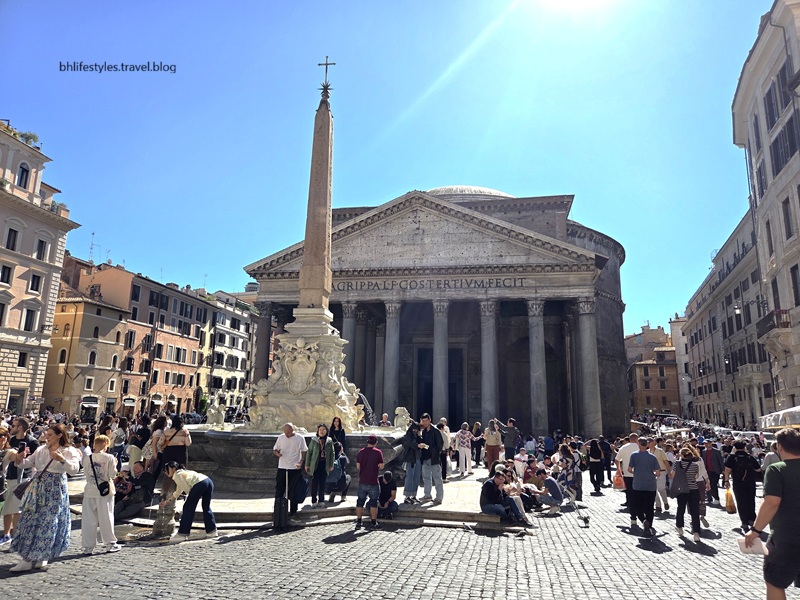
Behind the Pantheon you can see the curved walls plus looking down over the handrail you can see the original Rome ground floor level (7m below). Walking back, we find ourselves in the Piazza Trevi for more central fountains. Scott has a connected outlet where we are granted a free drink or Gelato, so we are granted 15mins of free time. My gelato was another thing I must do while in Rome, so another box ticked. I kept an eye on Scott where he was waiting but a couple of women were immersed in their gelato & wandered off too far. In these massive crowds they came over & grabbed me (I stood out in my ultra blue trekking coat). They were so relieved when I pointed out Scott in the crowd & they walked straight over. I think they would even hug him if they could. Scott stated it is the busiest he has seen Rome in October.

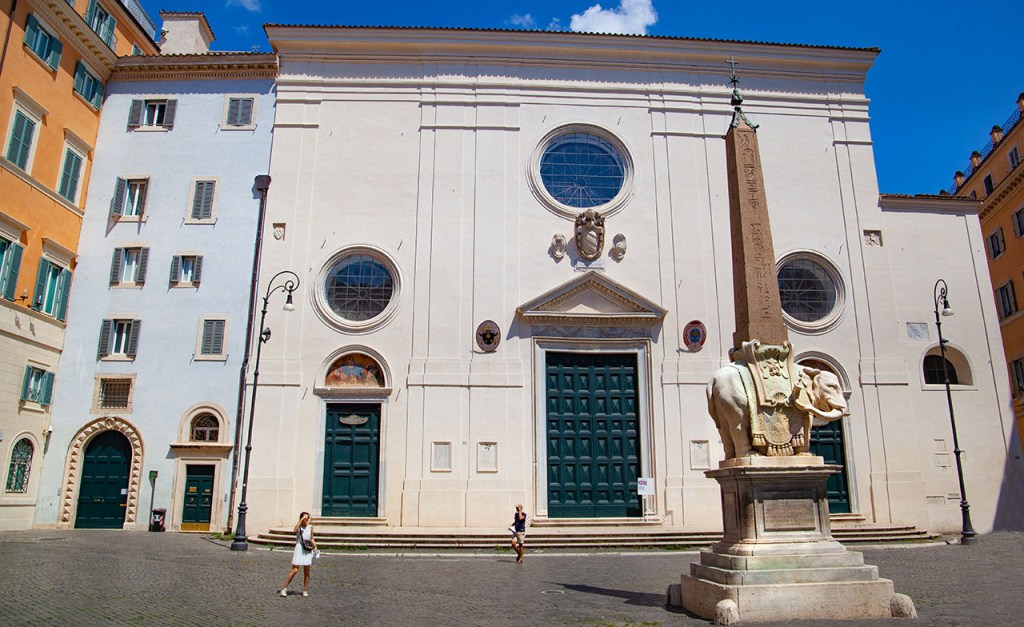
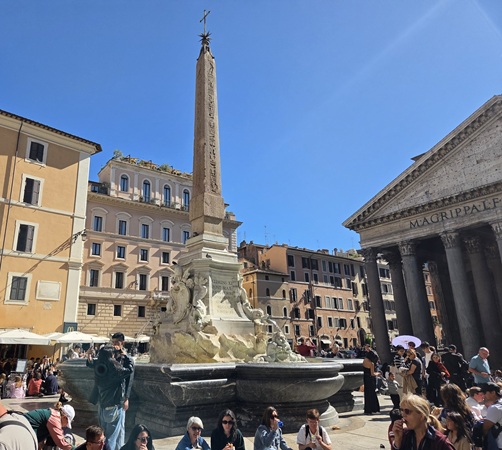
After our welcomed Gelato treat we head down an alley which then opened up into the Piazza della Minerva where the Basilica of Saint Mary of Minerva, a 13th century Gothic catholic church with a Michelangelo sculpture located within designed by Fra Ristoro de’ Campi & Fra Sisto di Firenze in 1280 however the basilica was not completed until 1725 after several changes. Scott tells us an ancient architect story where Bernini & another architect (name escapes me) competed to gain the commission to construct a magnificent building adjacent to the basilica. This building was being constructed (curved frontages depicts this architect) under the vengeful Bernini however, he won the commission to do the Obelisk out in the front in the Piazza.
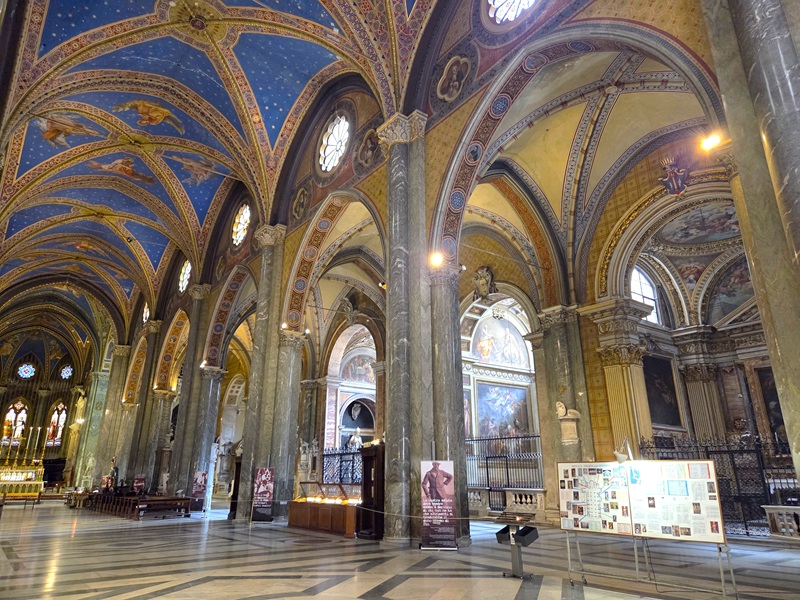
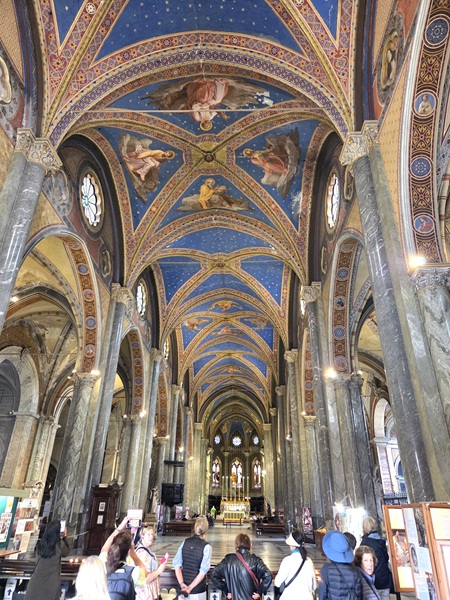
Bernini Obelisk

Bernini created an elongated rectangle spear with a tiny headpiece on top that resembled the learning knowledge of man & the weight it therefore carries. This spear was carried by his sculpture of an elephant for it’s the strongest of all living mammals that roamed the Earth that could carry this weight & has the best brain memory. The tale then turns that the elephant’s backside is pointed directly at the new building construction & still remains in place today. A well-known architect’s revenge. LOL!

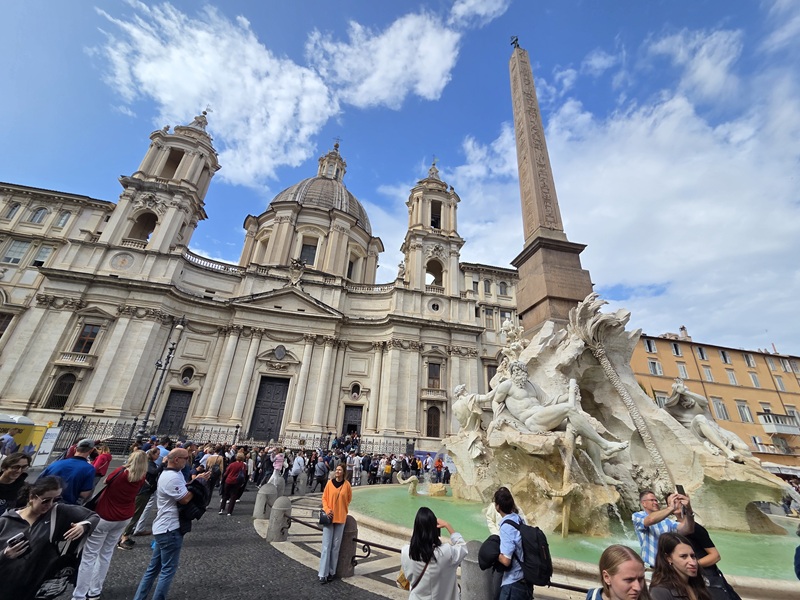
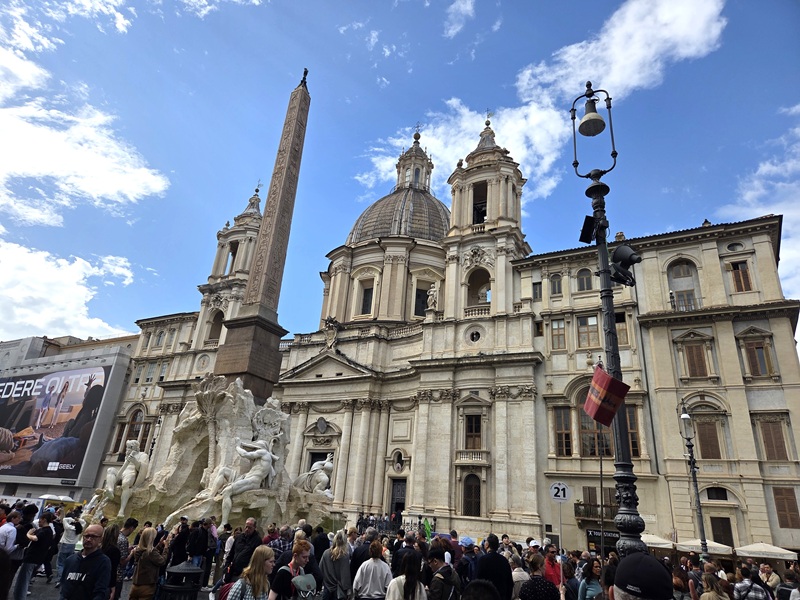
The last stop was Piazza Navona (2 photos above on the right), but we managed to sidetrack a bit & saw what is known as the Royal Palace which is an opulent building of grandeur. With our last good-byes to everyone, I decided to walk back to the Trevi Fountain, for that is the way back towards my hotel but can see some other sights along the way. Well!!!! The crowd now was insane. I had virtually no way of cutting through .. I just had to shuffle my way along until a crack in the crowd appeared. Heaven helps those trying to view the fountain. Totally insane!
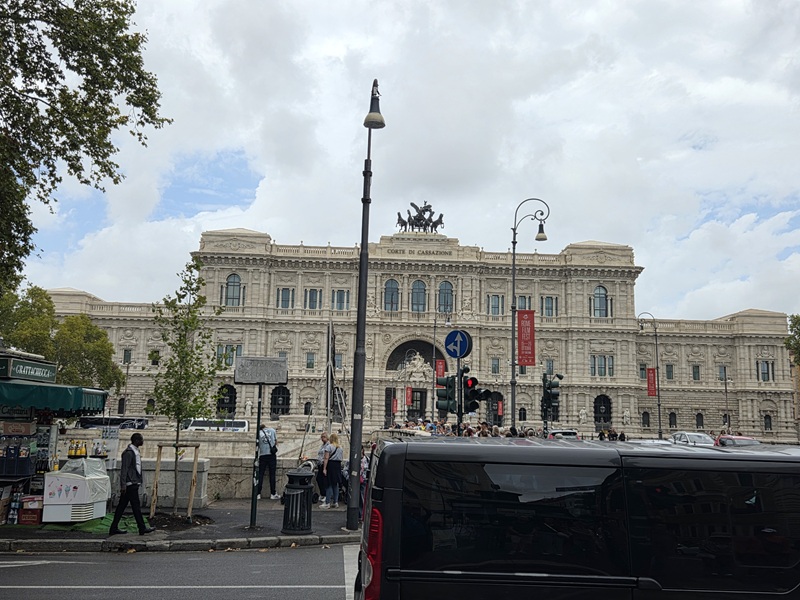
I must get up extra early the next day to catch the airport train to fly to Munich & then a train to Munich Hbf (Central) & then a connecting train to Nuremburg to stay with a young backpacking friend AJ (privacy) who I took around NZ Sth Island with my son Scott back in 2017. Her & her family have been hoping I could come over to see them one day with how we both looked after her. She had to trust an old man & his son for 18days. We all had a great time & not an issue for all that time & she remains in contact with me to this day. With my early rise planned for travelling, I decided to pack my bags as much as possible & have a nanny nap before heading out for dinner as a method of recovery from all my walking. Today, I managed 13,166 steps, 10.12klms. I’ll end my 5th Blog here & many thanks for reading them. My next blog will be my trip stay with AJ & Munich, Nuremburg, Tegernsee & her hometown in the winery area. Please stay safe, happy & healthy.
My Europe Tour 2025 – Blog #4

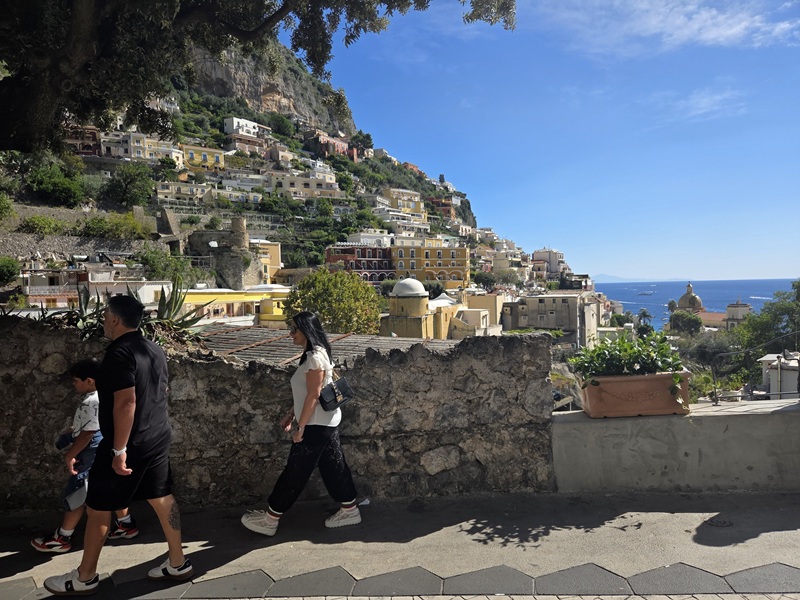
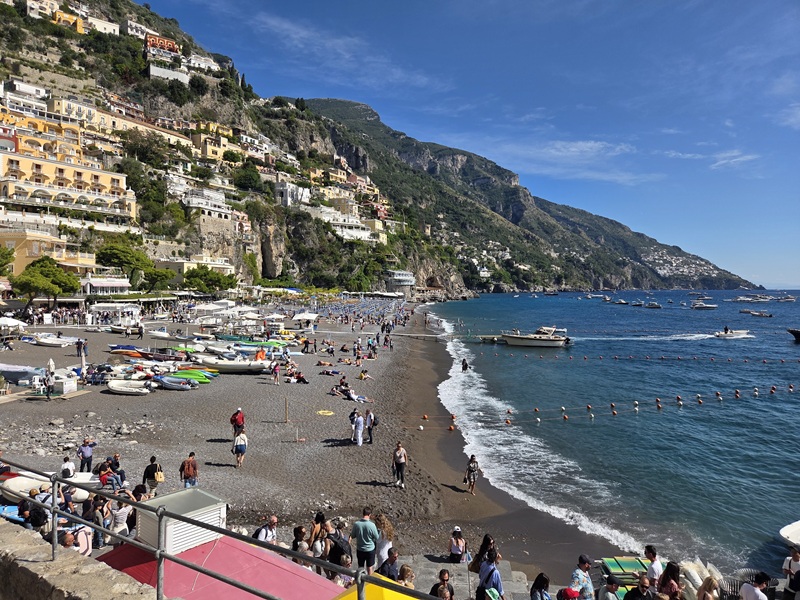
4th October 2025 is the day I take a full day bus tour South to Politano & Pompei to see parts of the Amalfi Coast trying to fit in a bit of regional Italy. I booked the Politano bus trip (some 13hrs) with a prescribed exact 7.15am departure. I arrived at the mtg point at 6.40am of Piazza Popolo (some 2.2klms from my hotel, so nothing like a brisk walk at dawn) & there was mass confusion with a lot of passengers that are taking about 6 different transport tours. Only 3 guides were there & it took some guests 2 or 3 goes to get a clear direction from them. I was one of them where I was told ‘stand over there‘ until 7am (3m away). To simplify .. I ongoingly approached 2 men & 1 lady & each time, receiving the same statement. When 7.20am came, I approached the woman again who said “your group has left” & indicated it was my fault. I was no more than 3metres from all the guides. With my following stern comment, she quickly contacted the bus where they waited the extra 5mins for me to walk there. Lavinia (our guide) was amazing & the only one who genuinely welcomed me. The front passengers just pointed their eye daggers at me. Very unpleasant. We had a full bus of about 40 people. My younger passenger next to me didn’t say a word until our break, some 1.5hrs later. People are so judgmental when they clearly don’t know the facts.

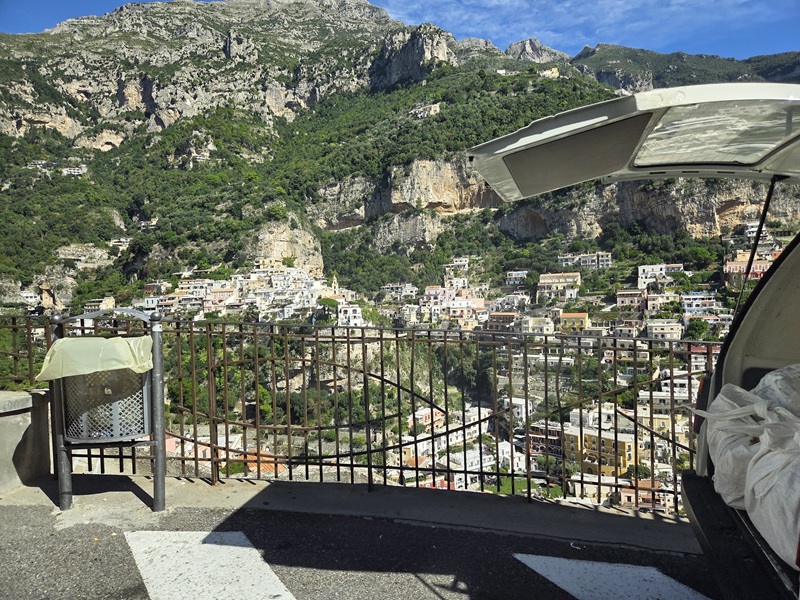
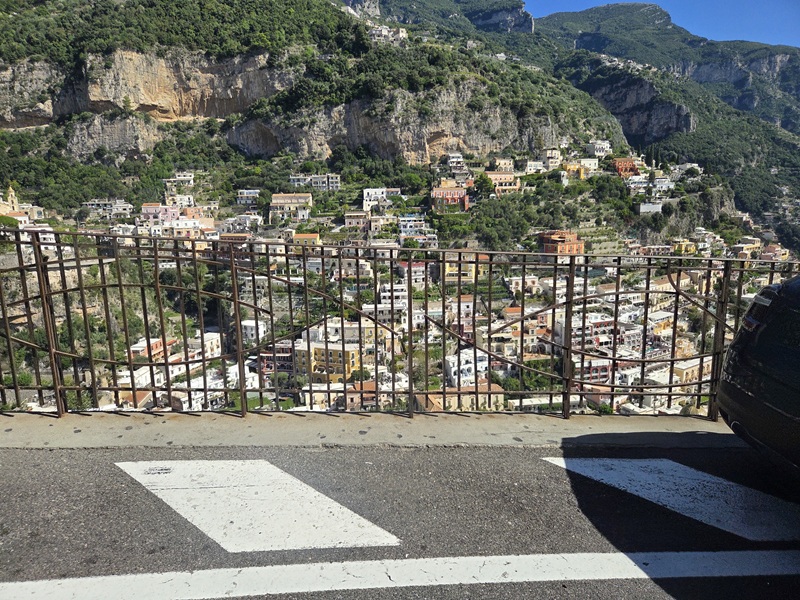
Lavinia gave wonderful commentary & had a great sense of humour & we connected well. The scenery was truly amazing, but I couldn’t get photos through the bus window due to my fellow passenger & as we became closer to Positano the bus decreased speed & started to do the tight bends matching the high terrain of the coastline cliffs & then we went to the next level of very tight bends & forcing cars to stop until the bus took the bend (the bigger bully wins over the cars). From about 10mins out (heavy tourist traffic) it gets to the point where the bus stops on the slightly wider, yet short section of road. Here we are to take extreme care in alighting from the bus & walking downwards to a fleet of 3 smaller bus vehicles to take us into Positano. These drivers are very skilled & know how to force their way through the crowds. Lavinia had to book our arrival time on the way to ensure the fleet of vans required will be available as there are other tour buses heading to Positano. There is quite a bit of punctuality enforced on this, such is the volume of buses arriving.

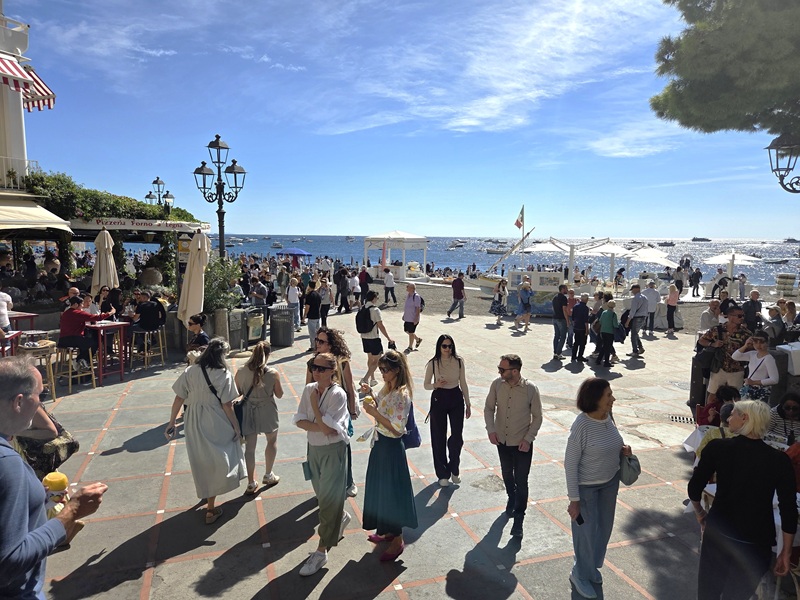
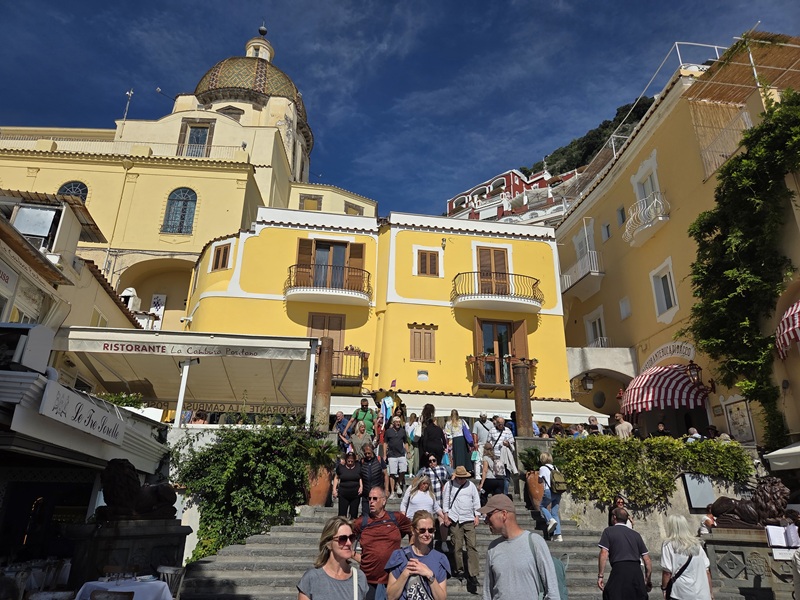
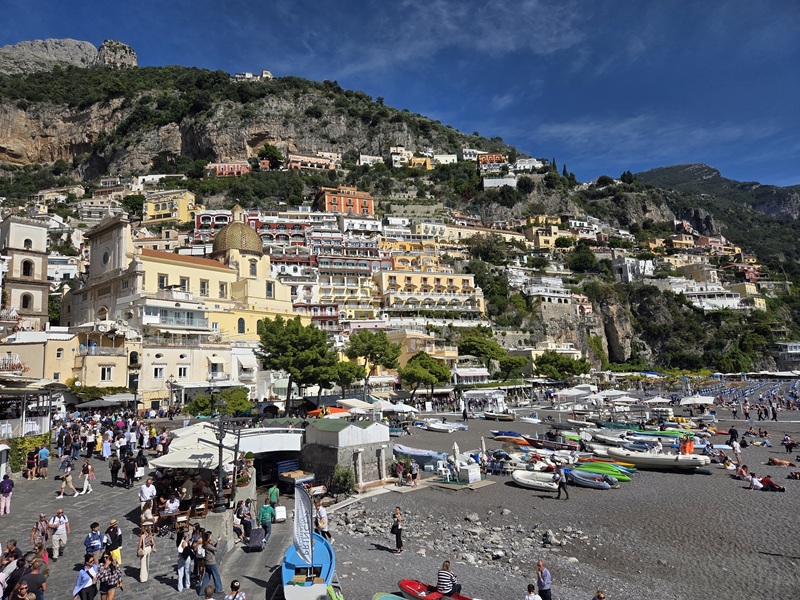
Once the 10seater vans drop us off Lavinia instructed us to meet up again at the yellow church (most small churches are yellow in Italy) leading towards the beach, some 300m below us. I was one of the first there but not confident, for the building here was extremely pale yellow in need of repainting. I looked up & saw the tiny cross with more confidence. LOL! Not long until Lavinia & all the passengers arrived taking up almost the entire street junction. She hurriedly gave us instructions in whether we wanted to shop or walk down to the beach making sure those doing that are health capable of doing the downwards & upwards journey. She had an old person suddenly die of a heart attack recently where help was not immediately forthcoming. This is now our free time to shop, wander or walk. The majority walked down the steep street lanes between the shops to reach the fine gravel beach of grey sand. Lavinia was standing alone with everyone heading out for their adventure. I offered her a beverage (beer or wine) as that’s what I do & she was quite surprised & in doing so had a great chat with our beers (cin cin is Italian for cheers) until she was summoned away by others. She couldn’t believe such kindness still existed. Cheers!!!

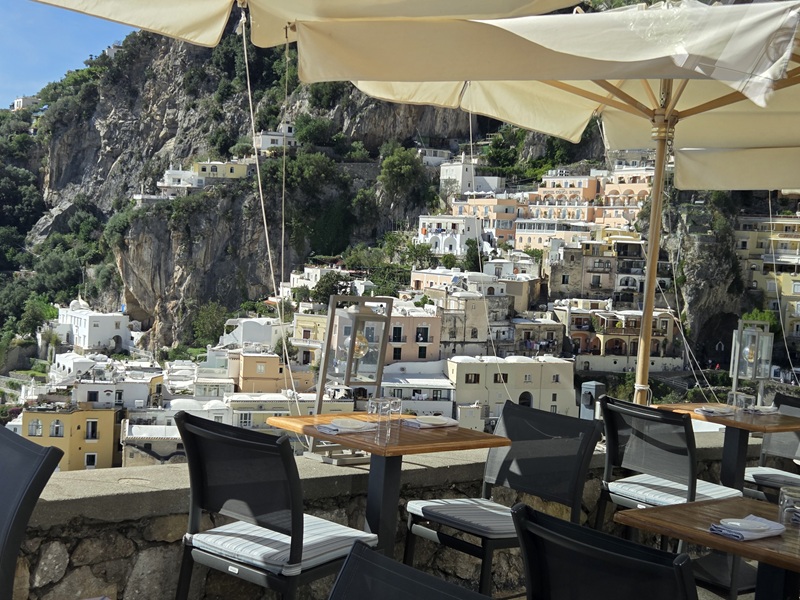
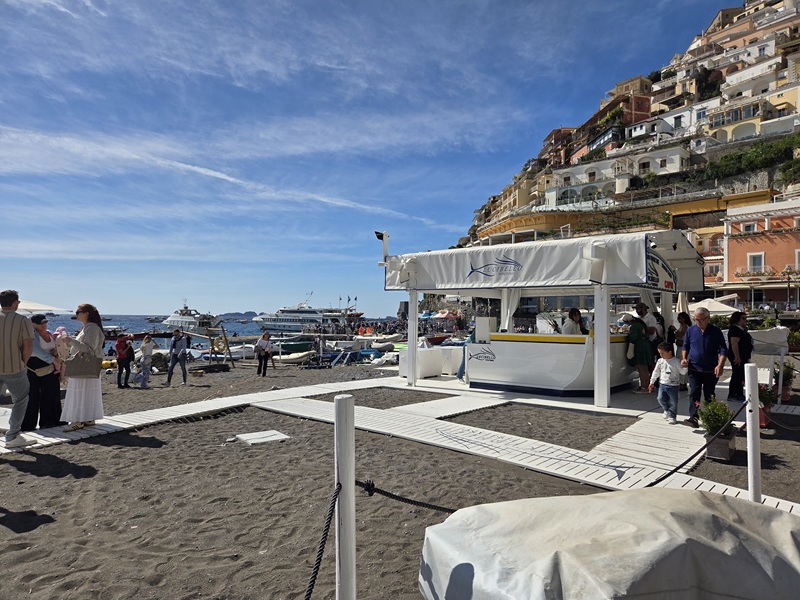
The ferry terminal is quite full of scrambling passengers & ferries go back to coastal areas, like Naples & other locations & it seems to be the smarter way of visiting Positano for the day than the insane road issues & on road parking. The ‘beach’ compared to our Australian beaches is far less in comparison but appreciate the Italians love any coastline access. Basically, there are no waves either. Certain elite hotels set into the hills have predetermined space setup on the beach with lounges, umbrellas, etc so the remaining public requires a bit of organising & scouting around for water access. The beachfront has shops, bars & cafes, etc taking every available space, so it is a relaxing but entertaining area.

After our designated 1.5hrs of free time we head back to meet up with the smaller vans for a faster exit to our bus higher up the cliff face. Due to the on-road parking, we are off the vans & walking along the road believing our bus is slightly downwards however, after reaching that bus our driver is madly waving at his bus, some hundred+ metres up the road making that journey involving more traffic risks, so be alert.

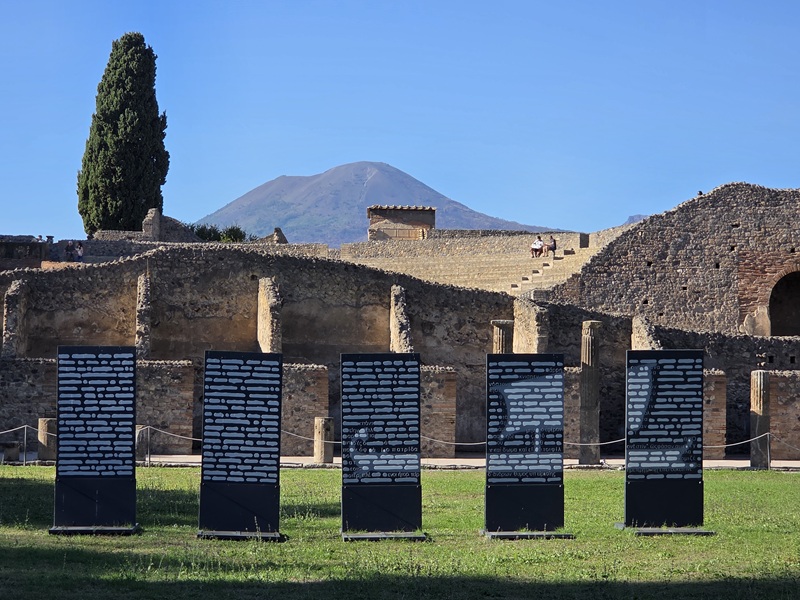
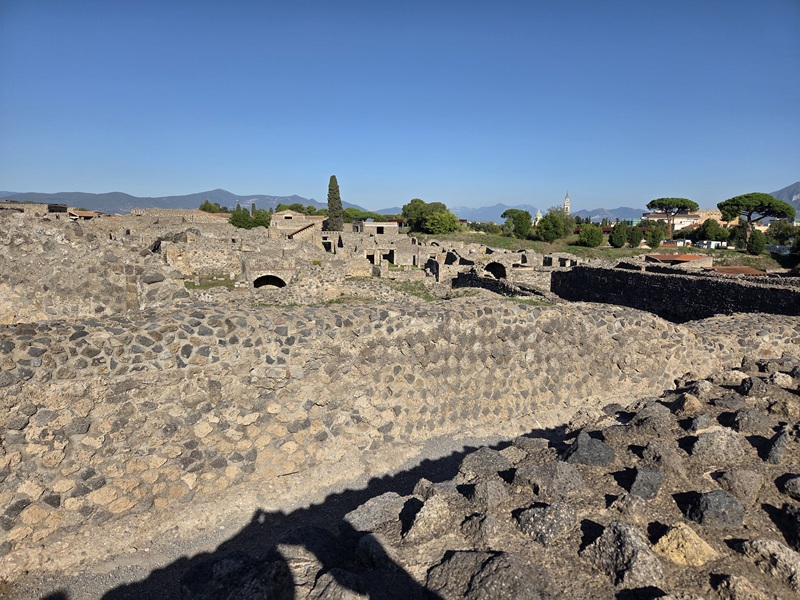
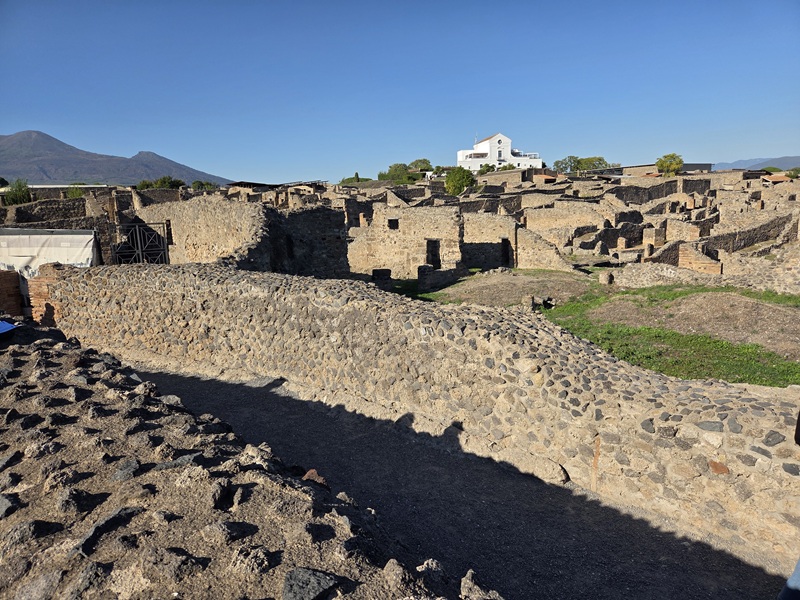
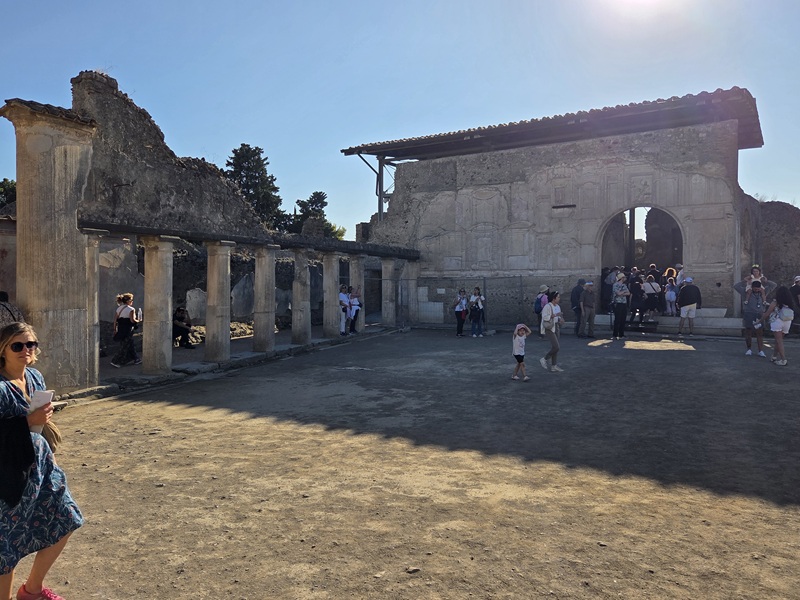
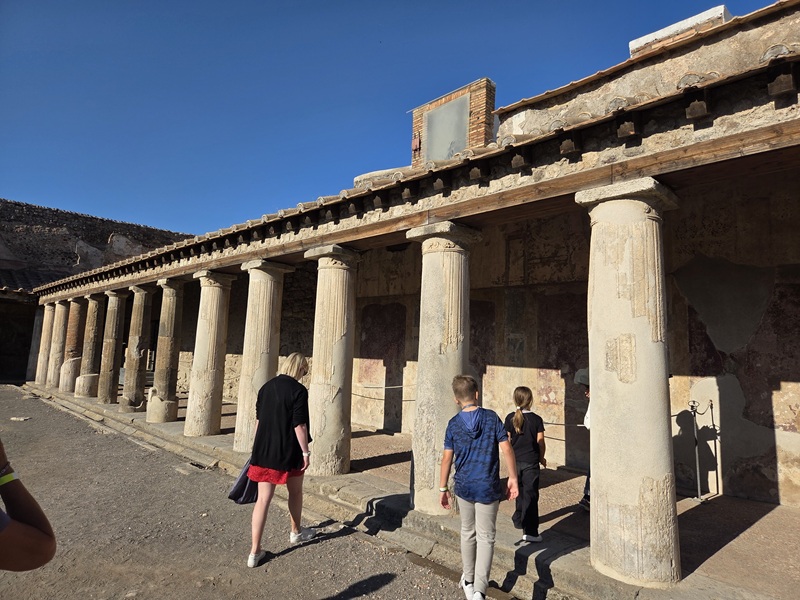
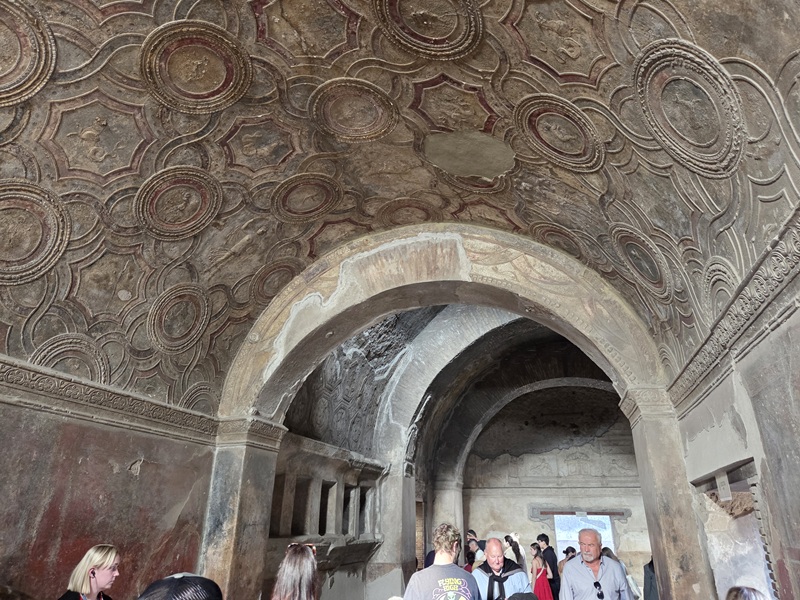
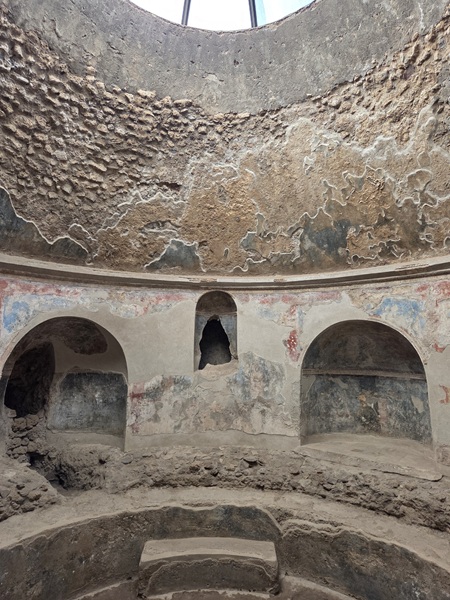
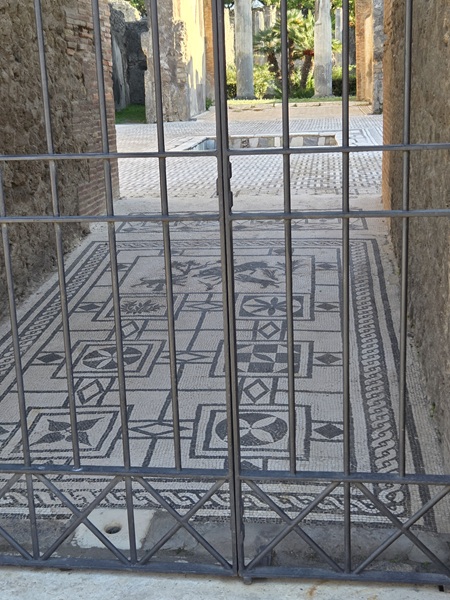
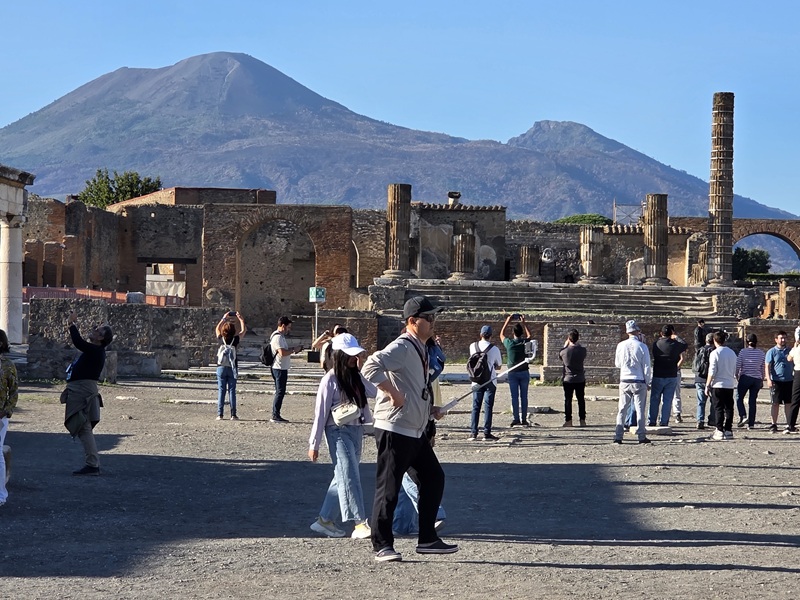
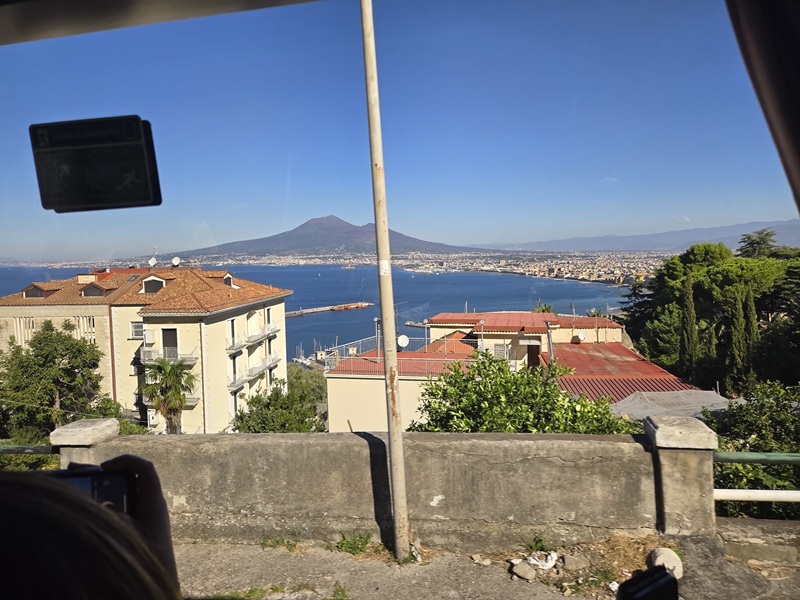
Pompei – Lavinia, when last arriving at the bus gladly pronounces, we have lost no-one & we are ready to make up time going to Pompei (closer back to Rome). Despite only 35klms away it will take us an 1hr in the bus with this terrain. With a little more open road you can see Mt Vesuvius in the background awaiting our arrival. Pompei is still an archaeological site & controlled by UNESCO World Heritage site funding. Pompei was home to around 10-20,000 people. Lavinia consulted the on-site guide personnel to obtain our access & headsets for the tour. Lavinia has her break now while we are escorted through the ruins. There is so much to see & to image life previously, for much of the ruins have been removed for other locations buildings, vandalism & earthquakes over the centuries. The township had its clean water supply & was heavily planned with aqueducts, although when inspecting closer to the buildings they had used lead piping (still present) which unknown to them was a poisonous material, especially in drinking water. Mt Vesuvius, close by Pompei violently erupted in 79AD. A severe earthquake happened in 62AD.

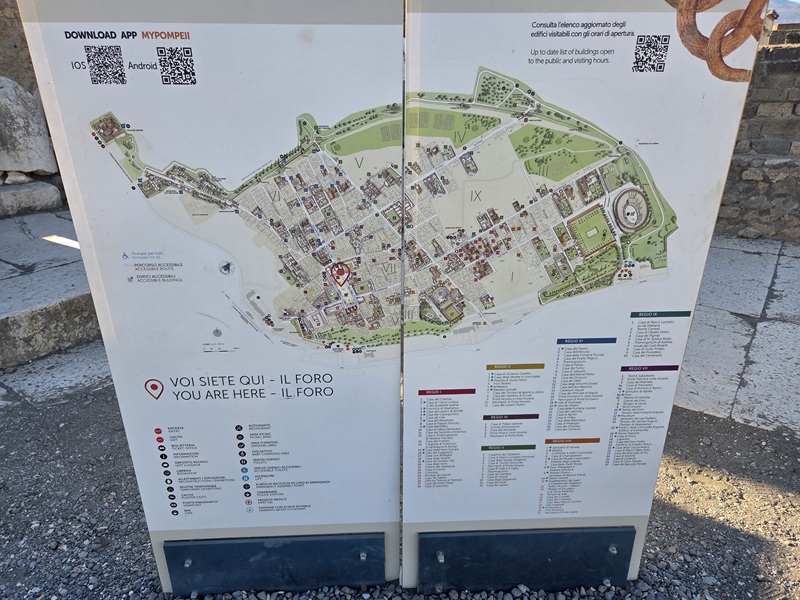
Obviously, I cannot write everything of today in Pompei, so I recommend seeking out https://pompeiisites.org as a wonderful resource to see how the 9 regions/ neighbourhoods were comprised of. Click on a region & several houses/ sites can be sourced. Pompei still has many areas to be uncovered to this day & well into the future. Pompei was covered in 7m deep of volcanic ash, but all that came well after the blast. Mt Vesuvius in my photo shows only 1/3rd of its original size to further explain the force of the blast & the flattened top, depending on what elevation you can view. The volcanic dust reached the stratosphere & hung over the ocean in a huge dark grey cloud & then the coastal breeze sent it directly over Pompei to settle over the entire region. The subsequent lava flows did not come near Pompei. Can you imagine 7m of ash to remove, but I couldn’t find out where they relocated that ash to.

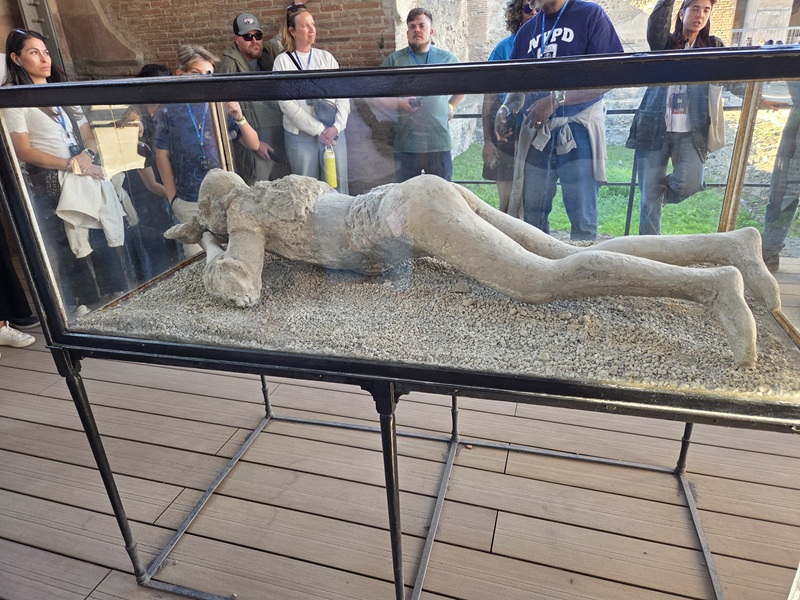
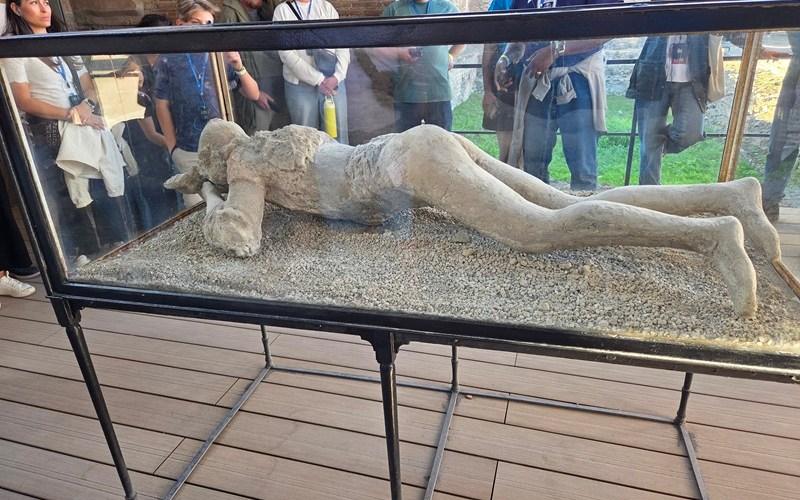
Upon years of excavations, human remains were found in various stages of preservation & when bodies were found it took a scientist to discover how to excavate the found shape without destroying them. Air pockets were found in various areas in their underbodies when the people mostly fell onto their faces trying to breathe below the ash. Most findings only showed skeletons.

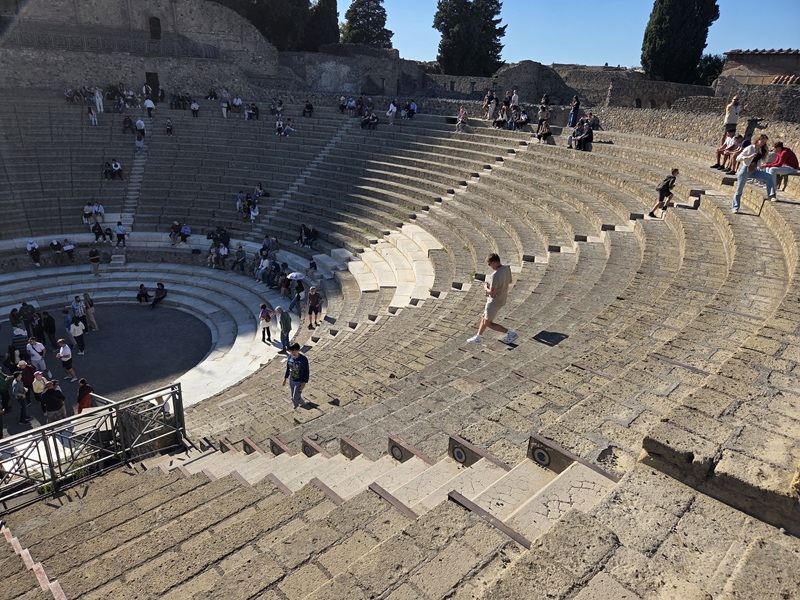
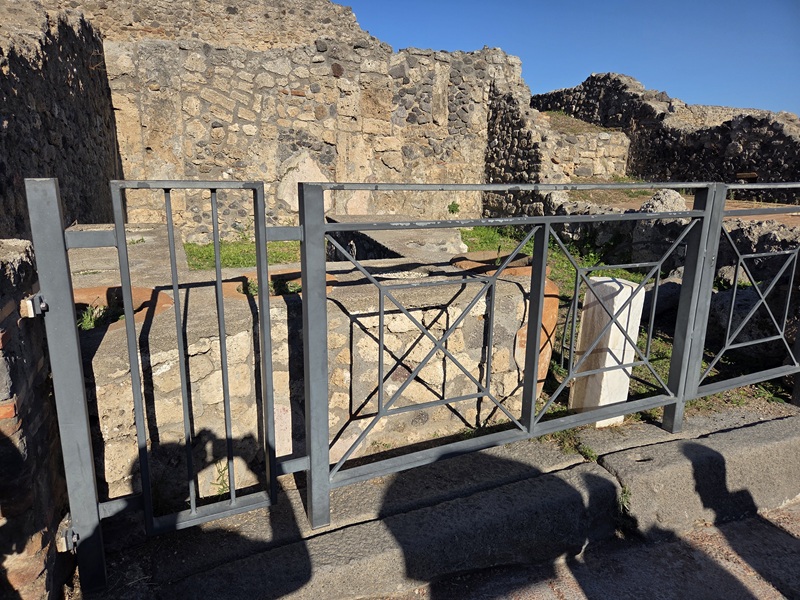
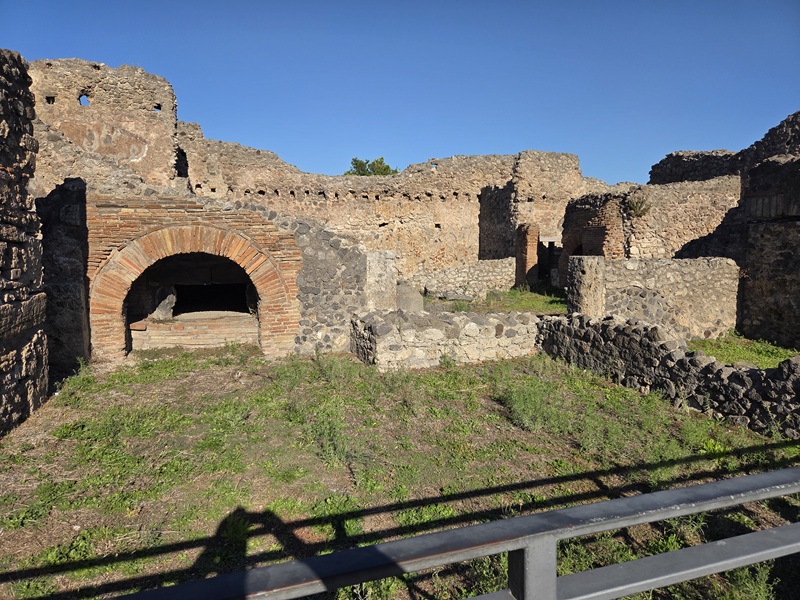
The excavators over the years provided a real skill in exposing the various structures, columns, roofs, staircases & such purposes these structures provided like saunas, hot baths, bakeries, shops, religious fonts & the list goes on. At some locations you can see a lot of exposed areas, but they are still far short of full Pompei exposure. After seeing lots of general building walls, roadways built for roman chariots & wagons with wheel grooves still showing, you come across certain large piazzas or courtyards & at last, the Amphitheatre where it is amongst the oldest of Roman times built in 70BC & hold up to 20,000people. Pompei was such a huge trading city being so close to the ocean & road networks, so it was very diverse & a real ancient metropolis.

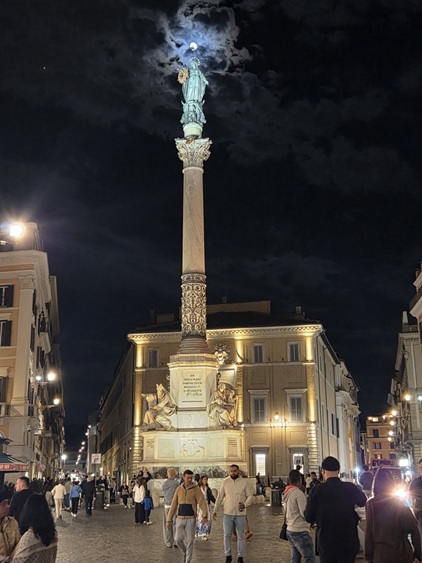
Piazza di Spagna

With our 2hr tour over we were back onto the bus & stopping for the toilet break at our previous Limoncello factory an hour away. Everyone after that was becoming quite tired & with the bus lighting lowered many were sleeping solidly until Lavinia hit the Rooster call tone (very funny), for we have arrived back in Rome at our original meeting point. I had a great good-bye from Lavinia & proceeded to my hotel via Piazza di Spagna (last photo) after a quick Pizza at a nearby restaurant & when I reached my hotel (25mins walk) I sent her a msg, again thanking her for a great day & to show her my formal review of the day to City Wonders, Viator & separately my overview of the ridiculous drama of that morning when almost missing my tour that she will follow up occasionally to see what will become of it. She was over the moon with my responses & confirmed this to me the next morning. She was on another tour by then. Arriving at my hotel at 9.35pm showed what a HUGE day it was. Shower & bed obviously.

I’ll end my 4th Blog here & many thanks for reading them. My next blog will have more pictures of major significance of the walking tour sights of Rome city. Please stay safe, happy & healthy.
My Europe Tour 2025 – Blog #2 – Rome

Day 1 in Rome – 2/10/2025

OK!! I’m now in Rome city (Historic Quarter & my first EVER day in Europe) 9am after my expensive train from the airport (Blog 1) & my first project is to find a café, for coffee & to use their WiFi as my Saily Data package has not evolved as promoted to me. Using my data provider on my original Australian Network will incur an obscene charge per day so I’ll persist in seeking out a better solution. I am without the internet & everything else. A wonderful café opposite to the Rome Termini (Central Station) was Sfizio & they were superb. Everything appeared to kick in on my phone with Saily once the WiFi took hold. I could now confirm where my hotel is (not far) but upon leaving Sfizio & a block away, I again had no internet. I finally found my hotel Bettoja Hotel Massimo D’Azeglio without Google Maps & left my bags at reception (too early to check-in) & took a map they had at the counter, as I had a Patheon Tour (Italia Explorer) booked for 2pm @ $21.84AUD. With plenty of time I headed off, but the map reading was all over the place. The thousands of people & tourists made walking the streets bloody hard & I found myself doubling back several times & not quite int the direction needed. The street signage was in a level of crap of small writing & not making sense!!! Really out of my depth.
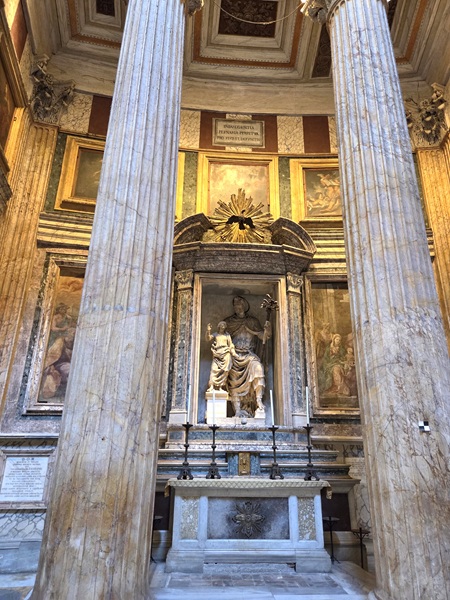
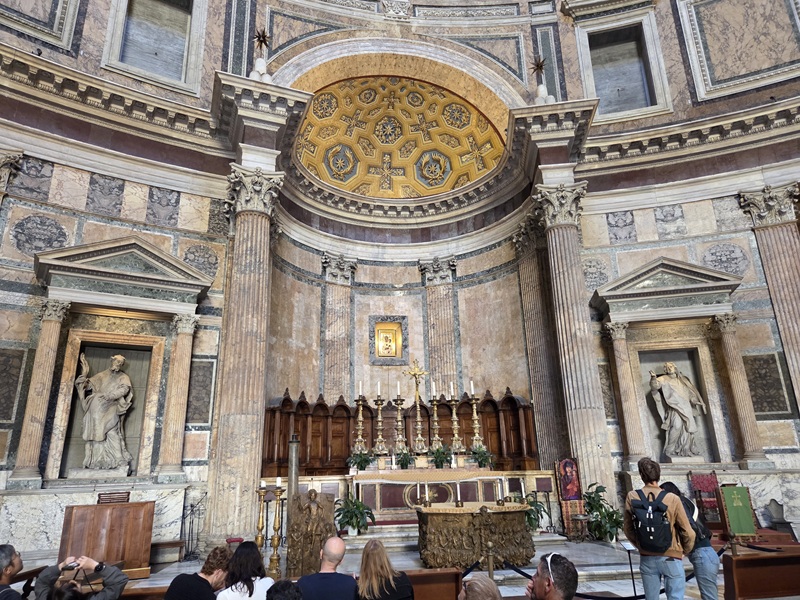
With frustration mounting (I had already done about 6klms of walking) & by the time I had found The Pantheon & my guide before the required deadline. He helped by putting me straight in (skip the line booking) which was a huge bonus instead of waiting for my designated time. The Pantheon was truly amazing & I can’t believe how this construction was carried out back then. The front 16 stone columns each weigh 60tons & were hand crafted in Egypt & shipped over. They used up to twelve elephants to erect each column. When inside, the wonder continues with great stone sculptures, arts & the world’s largest concrete dome of that type above us. The dome is 43.44m (142.5’) in diameter & is the largest unsupported concrete dome in the world & has had the record for over 2,000years (125AD). History does not record who built it, but it started in 27BC & was rebuilt to finish 125AD. The circular walls are 24’ thick & the entrance doors are bronze at 24’ high with an opening of about 14’ wide. The open eye “oculus” of the dome is a whopping 27’ in diameter & hardly any rain falls through it. The floor has a 1’ slope from the centre to accommodate any rain that rarely comes through it. For centuries experts could not prove the components of the true Roman Concrete of that age. The recipe had been lost long ago. With the latest technology used on original foundation footings still present today they found the vital ingredient which was the ash (white & grey pumice) from the eruption of Mt Vesuvius in 79AD over Pompei, etc making it the strongest concrete ever.

After the Pantheon I found another café with WiFi & contacted the Bot in Saily Support where the AI really can be scary .. so human like in answering & it diagnosed my phone was cutting in & out with the Airplane mode. After a few interactions & waiting the required seconds on the mode setting Saily cut in fully & no more problems after that so it was easy to find my way back to my hotel. I am now aware the Airplane mode can be erratic. My Samsung Health App notified me I had walked 23,705 steps equaling 18.56klms if you don’t mind. Yikes!!!

Upon returning to my hotel, quite close to the Rome Termini Station (Central) I was quite shocked trying to convince the reception staff on my check-in stating they had my bags in storage that morning. Finally, the staff realised I was in the wrong Bettoja Hotel, which was directly across the road from my Bettoja Massimo D’Azeglio. I was informed the father Bettoja had 3 hotels & upon his passing, each of his 3 sons inherited a hotel each & they are near each other (Mediterraneo was opposite & Atlantico on same block but further down). They are stunning hotels & had better get my attendances right over the next few days. LOL!! Finally settled into the night & sorting out my 4day stay & to get ready for my early morning Colosseum tour (1.5klms, 18mins walk away from my hotel).

3/10/25 Day 2 The hotel delivered my brekky right on time so heading out in the late dawn went very well. After lunchtime I must walk from the Colosseum over the River Tiber to the Vatican (50min walk, 4.1klms) for that tour. A HUGE day of course. My Colosseum, Roman Forum & Palatine Hill Areas Tour by Crown Tours through Viator, was for a 9.30am start where the meeting point was 20mins walk away & I detest being late for anything. It is critical to organising an early morning tour, as by lunchtime the volume of people at the Colosseum is beyond ridiculous & the temperature is more comforting. Our guide was Annalisa, a documented archaeologist who apologised frequently in confirming a lot what we have been shown & taught are so out of touch to the real history we may become upset or disillusioned. The Gladiator movie was an example where it was more of Hollywood illusion of course.

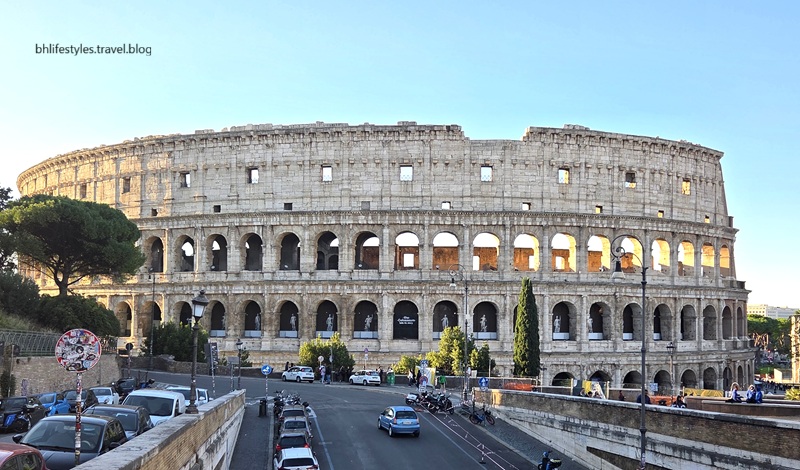
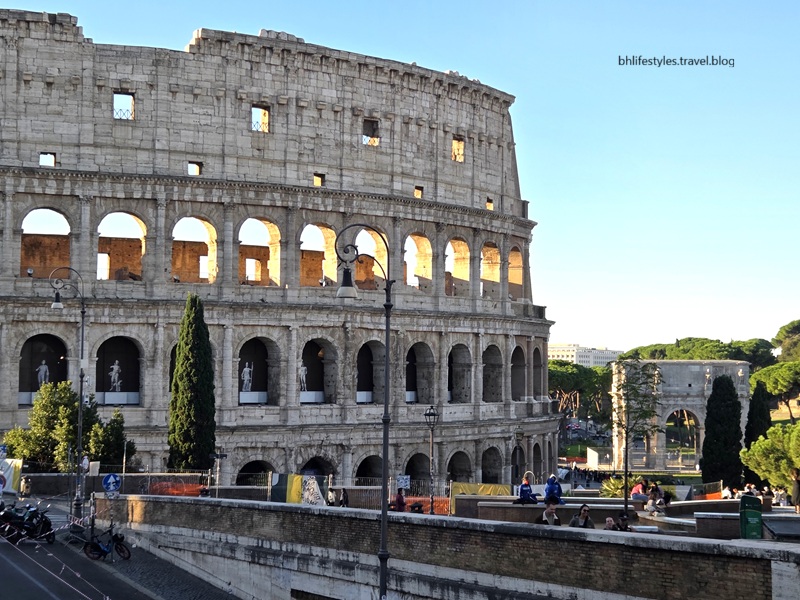
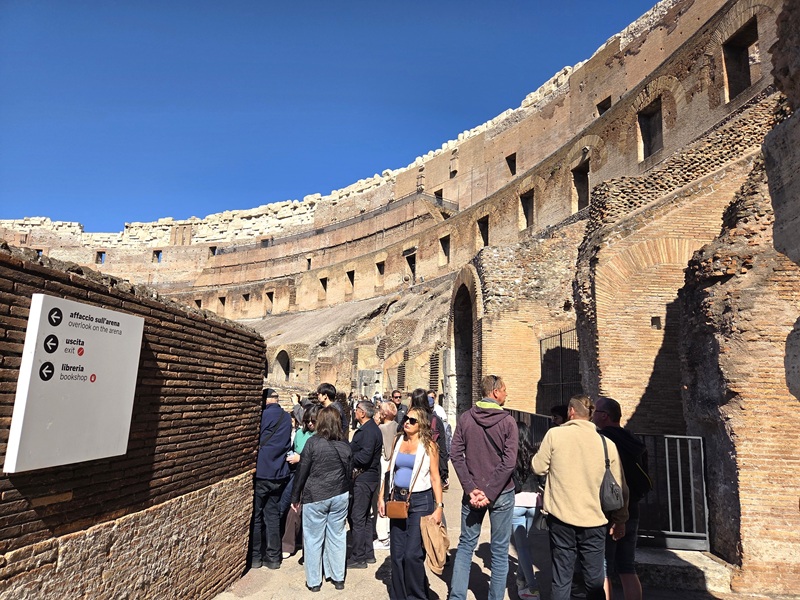
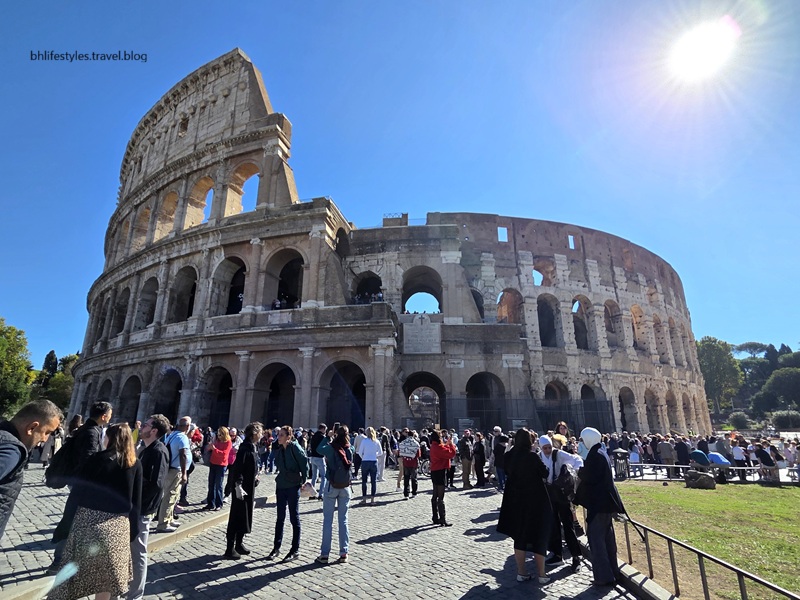
After the viewing in awe of the Colosseum structure as we walked closer for its massive size you notice a side section is missing of its upper decks. This was due to outside thieves or colonies stealing the blocks of limestone/ travertine blocks for their other infrastructure which was an ongoing crime as building resources & workers were hard to get. The other side of the Colosseum was inhabited by a large village; hence blocks couldn’t be stolen from there. Due to the ‘vandalism’ it weakened the structure & when a great earthquake happened in 1349 & some of the fallen debris eventually was used to build hospitals, palaces & other structures. In a lot of walls of blocks, you can see small holes chipped into the blocks where the rare steel metal joining spikes were removed for other structures in time. This also weakened the walls.

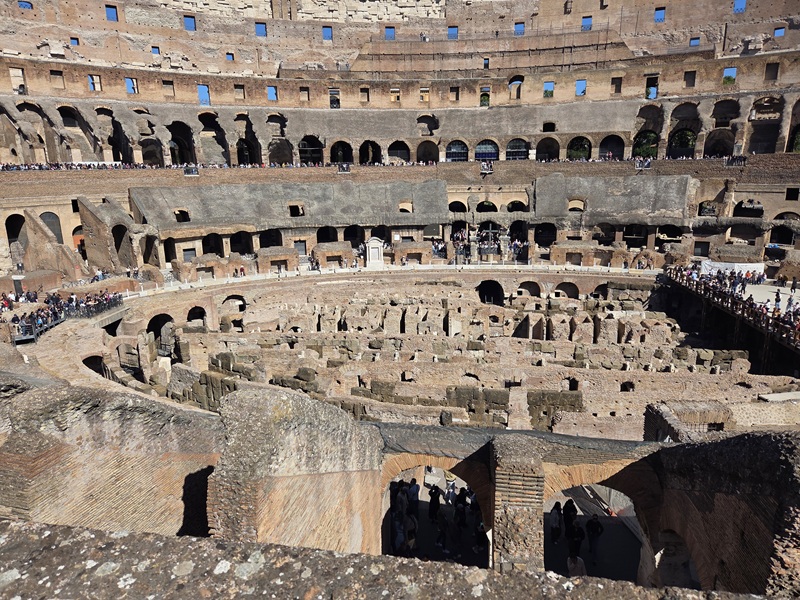
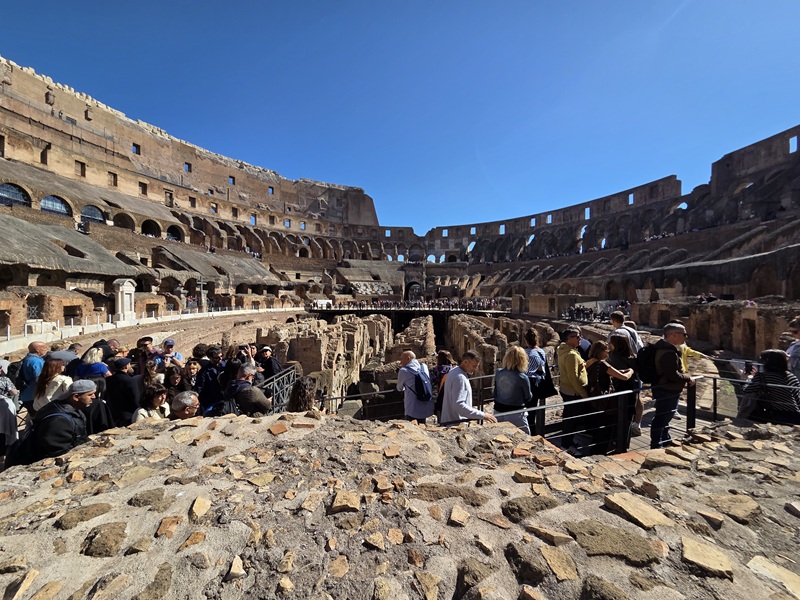
The Colosseum was built in just 8yrs (72AD-80AD) using over 100,000cubic metres of stone & Roman concrete. After the fall of the Roman Empire the Colosseum was abandoned & fell into disrepair. The arena was a timber floor supported by numerous brick walls as per my photo. Sections of the floor was raised vertically by means of the adjacent aqueduct system that hydraulically lifted the selected platform for better public viewing when required. The underfloor structure, known as the hypogeum, consisted of numerous alleys of brick walls & cages where animals were caged for hunting performances. The next fighting gladiators were housed there just before their fights were to take place. The remaining gladiators were kept longer outside the Colosseum for relief & training & entered the arena underground by a tunnel. Gladiators were well paid by their schooling master’s & not killed merely for sport as per the movie The Gladiator. Their surviving skills kept them in a good financial status, but no life was long in Rome those days but not every gladiator was eliminated, unless they were poor performers.

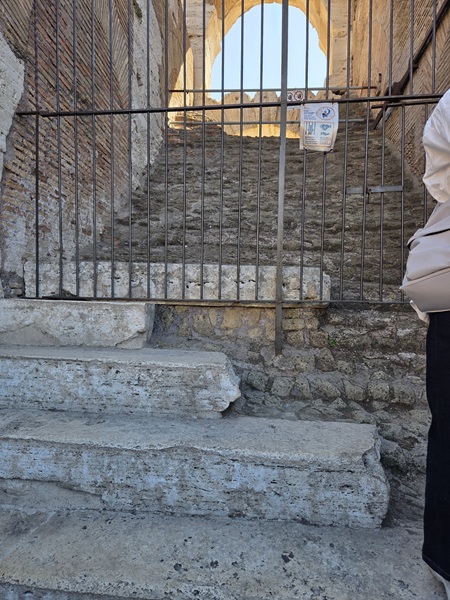
The arena floor was also treated with a small layer of sand for the shows to reduce the effect of blood volume & slipperiness, mainly from the animal kills & not so much from any gladiator kills. Animals were hunted & slaughtered far more than any gladiator. If you look closely at the interior photo you can manage to see there were 5 seat terraces (see the staircase remains) where they placed all the lower-class people up onto the highest level, for their role was to cheer the loudest & to confirm if the losing gladiator was to live or die. The decision was decided by the volume of the cheering, not the emperor’s, thumbs up or down.

Everything you view is of a grand scale & it is hard to understand just 8yrs to build. On the eastern side, when you walk around you can see the original Rome floor was some 7m below the current ground level. This area would flood so over time the romans would build over what the floods provided with more soil making it now 7m above.

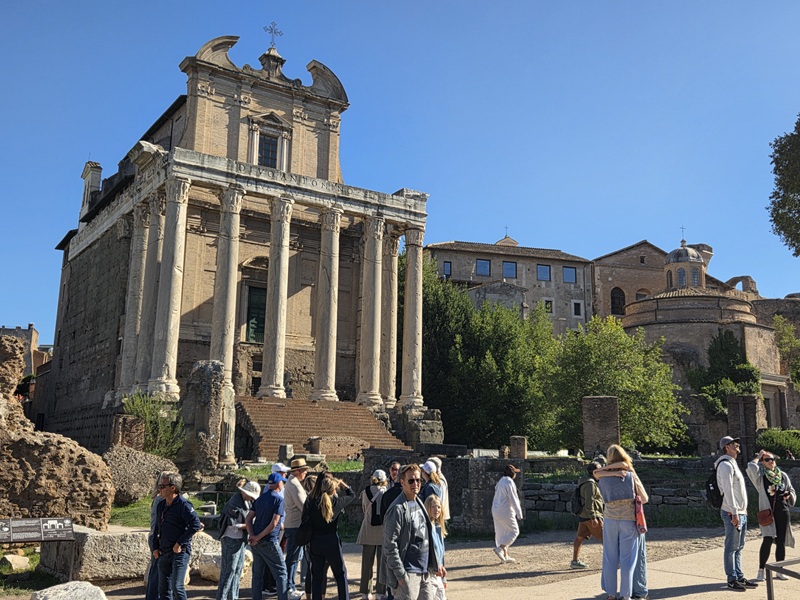
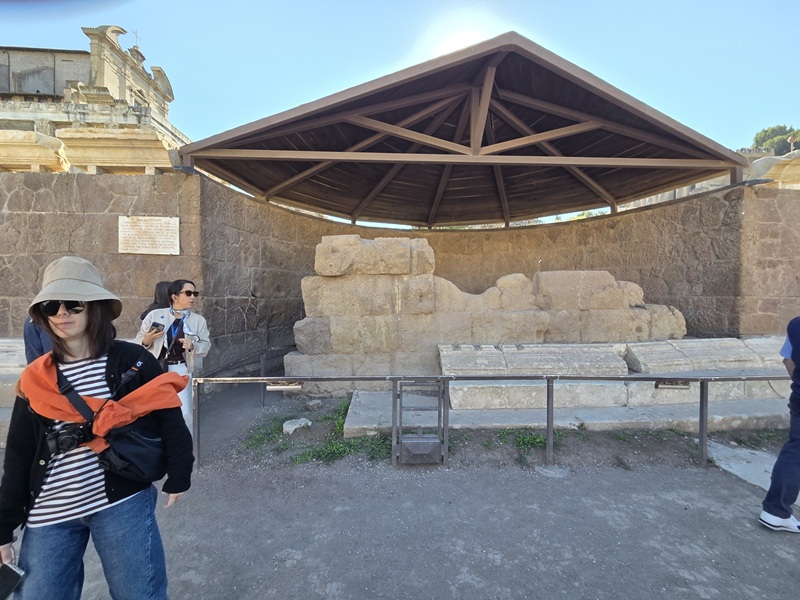
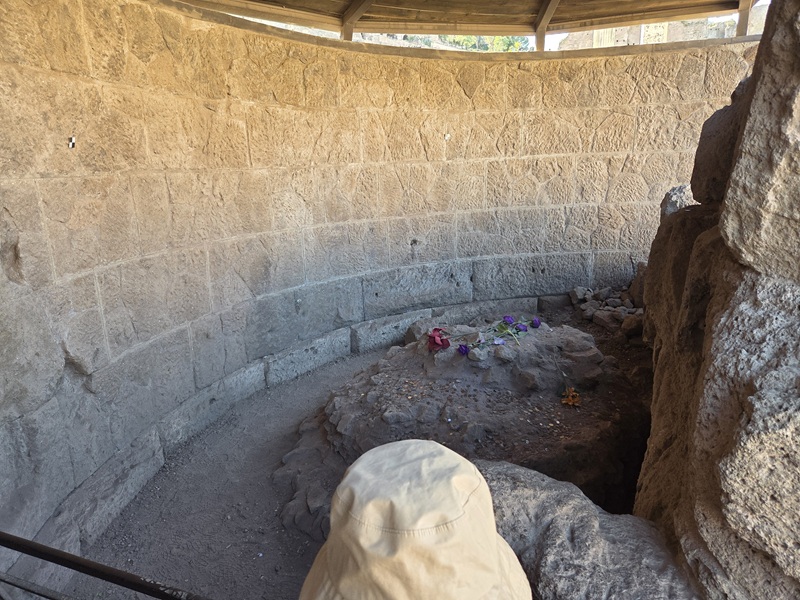
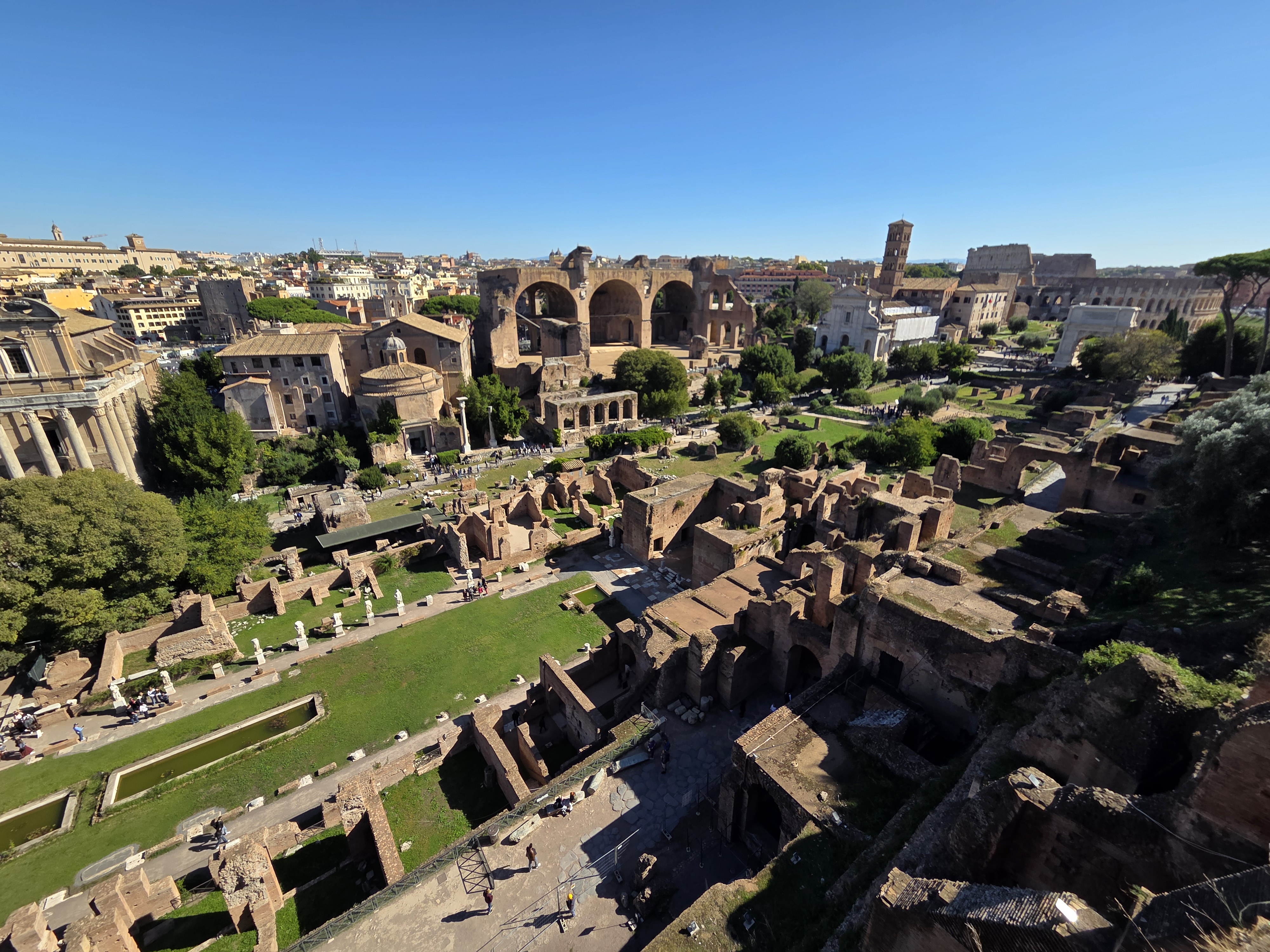
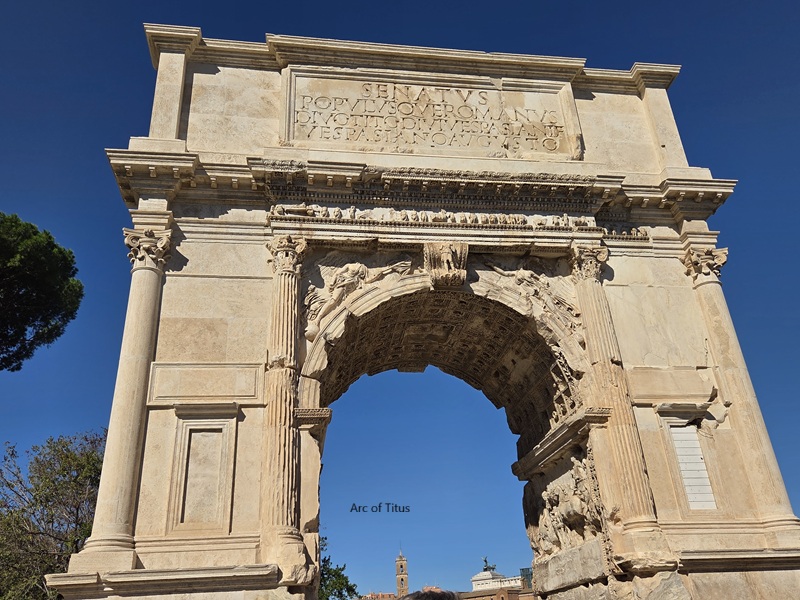
On the same side you can see the remnants of the high-level aqueducts that fed the water into the sub floor of the arena area for the hydraulics to work. The sub-floor would be flooded for approx. 1m deep. This again is confirmed when you venture adjacent to the Colosseum on the western side called Palatine Hill which also shows more intricate structure history including aqueducts over this expansive area. In the lower area, there is a small, curved wall with a new protective roof over it & this is where Julius Ceasar was assassinated by a stabbing. There is far too much history to type, discuss & take photos, so you must come to Rome for yourself & it would be a bonus in scoring our guide, Annalisa who is a walking encyclopedia. Enjoy the photos & look closely at the detail.

I’ll end my 2nd Blog here & many thanks for reading them. My next blogs will have far more pictures & of major significance of the major sights of Rome starting with the Vatican. Please stay safe, happy & healthy.