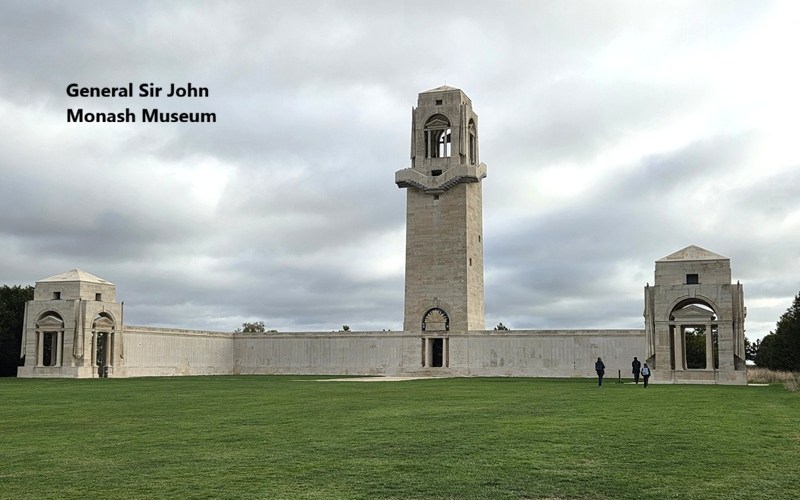
Blog #13 – Amiens – Villers-Bretonneux 21/10/25 Today is an extra special day thought about long ago. It is about a ‘promise’ I secretly made to myself to visit the war area surrounding Villers-Bretonneux & The General Sir John Monash War Memorial just out of town. The promise came about when I was trying to organise a trip in 2017 for the 2018 opening of the underground War Museum at The General Sir John Monash War Memorial with my youngest brother, Rod but I won’t go into why he couldn’t agree but it wasn’t his decision not to. Not long after my first planning of this trip & discussing it with him Rod suddenly passed away (at only 54). Rod was an avid reader of books on WW1 & knew a lot more than I on the subject. After he passed away, I made that promise to myself to take him with me .. much like I’ve done on every trip since 2017.
I have read 2 large, detailed books on who I call our greatest ever Australian, General Sir John Monash who landed on Day 1 at Gallipoli 25th April 1915 & through his efforts & strategies saved countless lives & later ensured the safest retreat from the bloodbath of Gallipoli & in 1918 took control of the whole alliance armed forces of countries (England, USA, Canada, NZ & other countries) in an orchestrated front to defeat the German army. He was the only one to ever achieve that chief honour of such a combined force. Only cruel politics kept him from being rightly called Field Marshall, for he was born in Melbourne of German Jew parents & as he grew always called Australia his country despite his heritage. Too many Field Marshalls & Generals failed miserably throughout this war until they reluctantly took notice of him. He brought the war to an earlier end & saved countless thousands of soldiers & civilians. He was the only Commander to be knighted on the battlefront for about 200years by a reigning monarch, King George V through his amazing & accurate strategies mentioned above. After the war, he also brought reinforced concrete to Australia through Monier, built & designed bridges & rail networks, electricity networks, chief organiser of ANZAC Day marches & Remembrance Day & the repatriation of soldiers & the list goes on. Every student must read his life stories & his achievements, for they are amazing. His name is honoured by universities, highways & hospitals, etc.
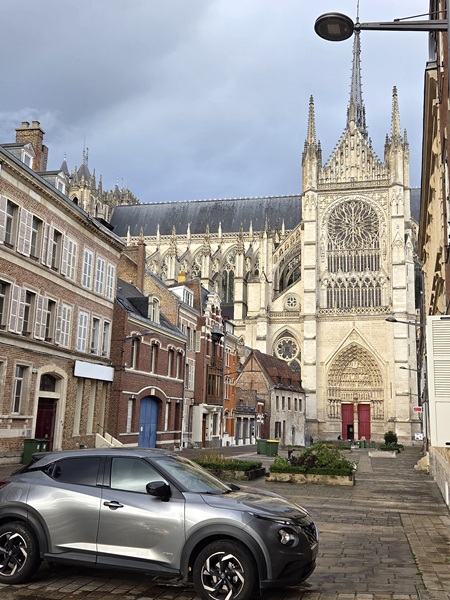
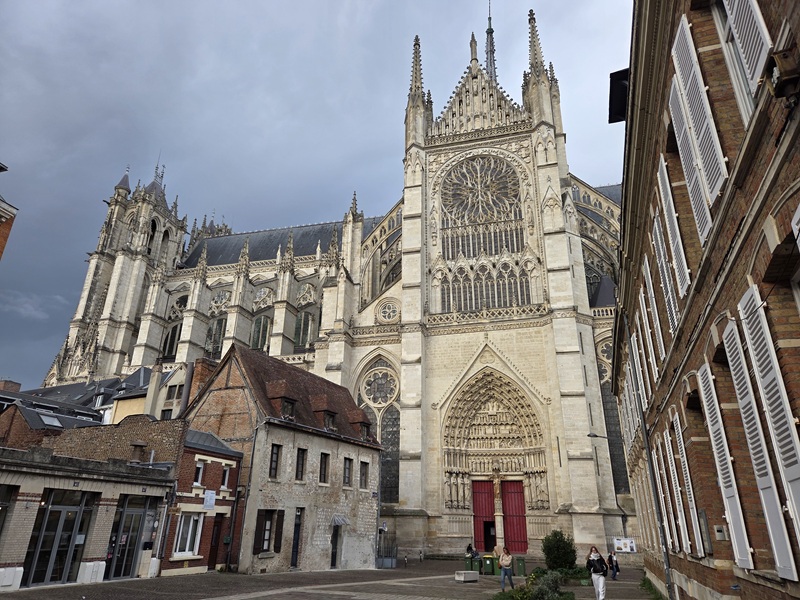
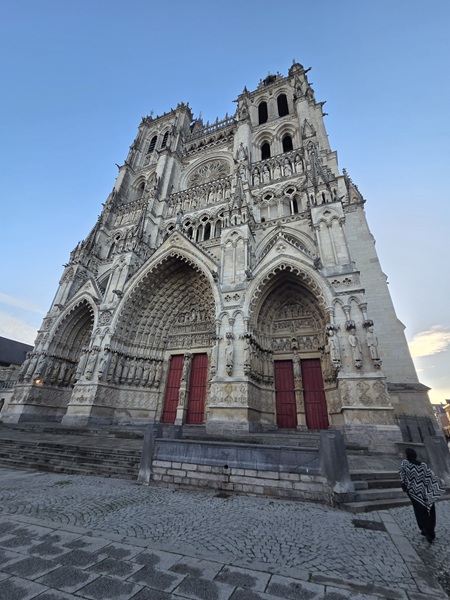
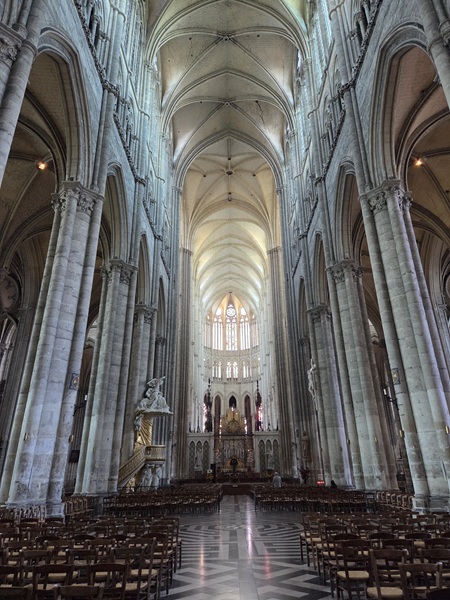
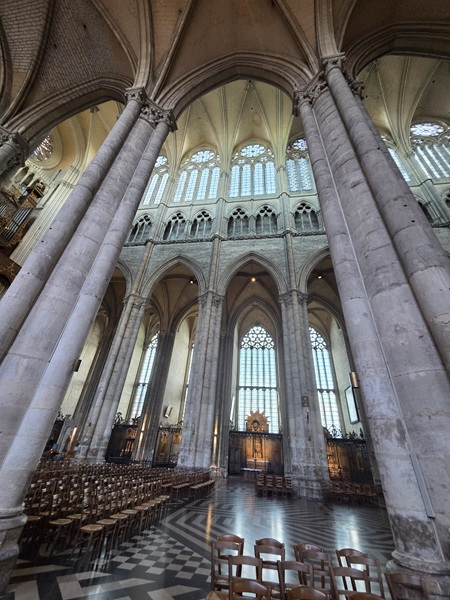
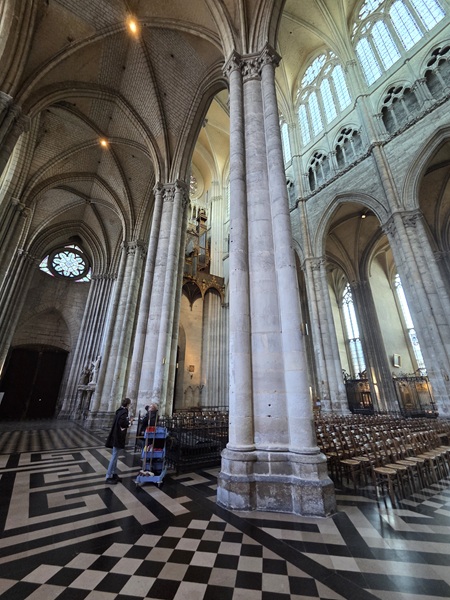
So today, 21/10/25 at 9am I meet my guide, Bridgitt on a Tripadvisor 8hr tour – Australian Battlefields Tour. Our first stop is where I met Brigitt at the Cathedrale Notre-Dame d’Amiens, just 200m from my apartment. This Cathedral celebrated its 800 years birthday in 2020 with the first stones laid in 1220! She is the largest gothic medieval cathedral in the world, double the space of Paris Notre Dame & has a 112m high spire. . We also have the opportunity for an early morning peak & to hear the large pipe organ being practiced on. What a sound! The bishop, before the war began, wrote to the Pope asking for him to ensure the German’s don’t destroy the cathedral. It worked however, the bishop being less positive made sure the elaborate stained-glass windows were removed & stored in a large warehouse for safe keeping. The warehouse was eventually blown up by the Germans & only 2 windows survived as per my photo. The ceiling is solid stone & vaulted some 30m high which is an amazing sight in itself. There is just too much to see in this cathedral as well as the insane detail on the outside, carved in stone.
Moving on, you can see the beautiful rolling landscape of the Somme region. Farmland everywhere & perfectly manicured of sugar beet & seed sown ploughed acreage. The cows are kept warm in large sheds & allowed out twice a day, then milked. Such beautiful scenery now hiding the devastation of war.
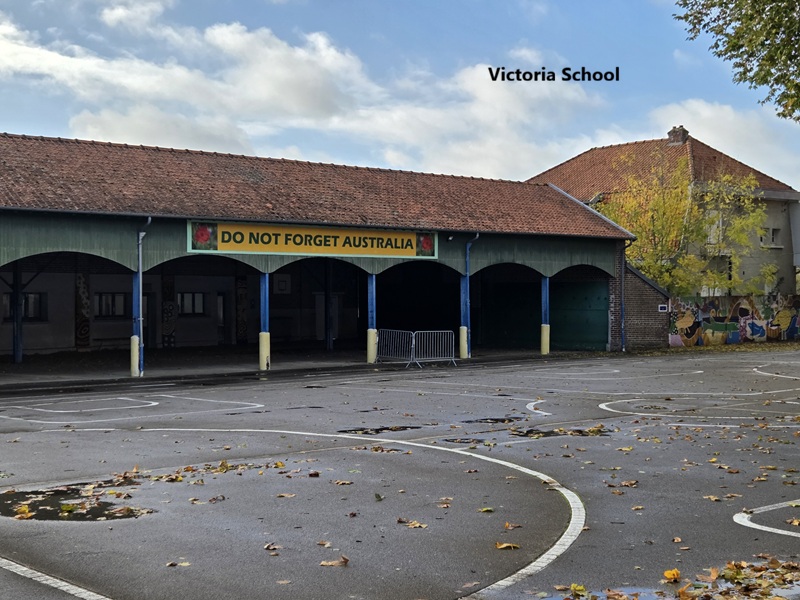
Villers-Bretonneux is only a few kilometres away from Amiens & is a much smaller village but it has a stronger connection to Australia & it’s almost a religious following, as Australian troops saved this village & many others. There is a school, fully funded by the State of Victoria & is called Victoria School. Each student is fully schooled on the ANZACS & Australian history & culture. Robinvale in Victoria became its sister city in 1984/85 & the townships have had a close bond ever since. I had a chance look into the school due to school holidays & there’s certainly a lot of Australia here.
Just outside the township we visit the Villers-Bretonneux Military Cemetery linked to the Australian Memorial where Bridgitt explained the role to undertake the carving of the Portland stone back in England & shipped out for the required grave after the soldier was clearly identified. Some families were even allowed to have something carved on their headstone along with their regiment or country war insignias, etc. Sadly, the Portland stone is a bit porous & some erosion is happening, making them difficult to read depending upon wind, etc. We saw 2 headstones side by side of 2 brothers who enlisted together & died in the same trench. One was 25 & the other 31yrs old. What a shock for the family.
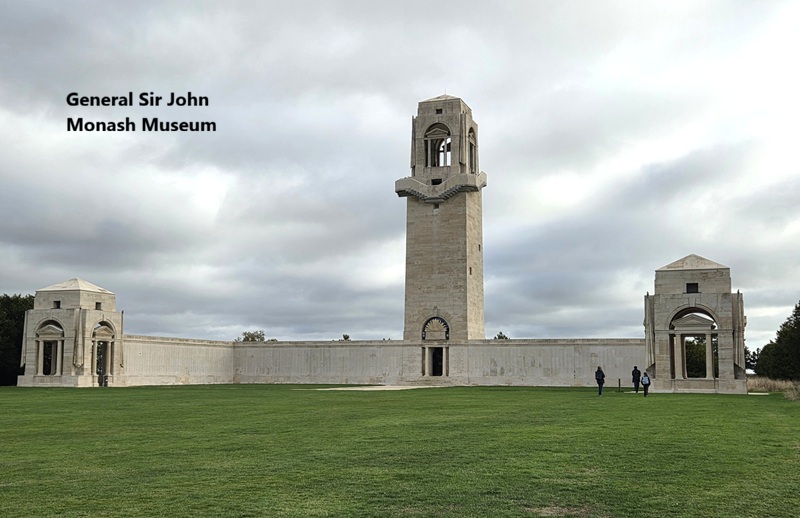
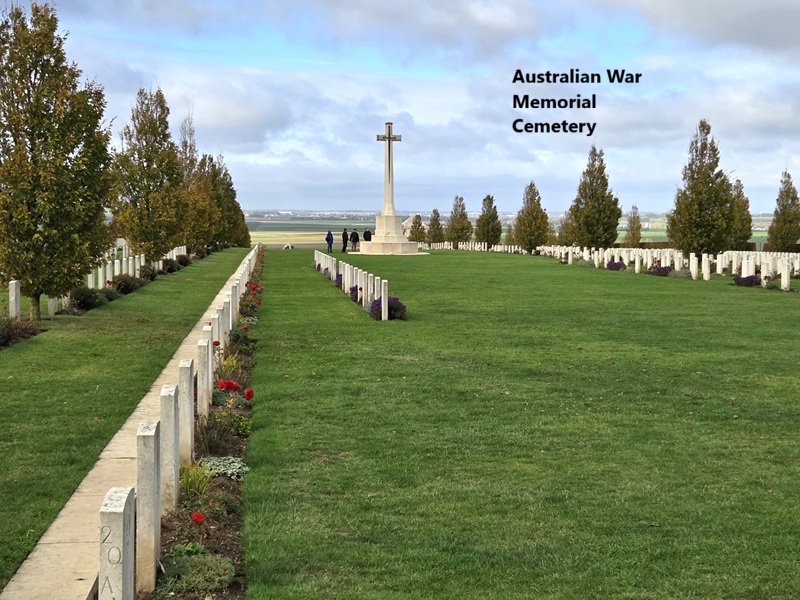
Turning 180° from the thousand or so headstones, we walked a short distance to the General Sir John Monash Museum where thousands of names are engraved on external walls who could be identified who died in this region. I believe there are 300,000 still declared as missing (never found or identified) for this war. The Western Front & the counterattack led by the Allies in April 1918 shows the amazing courage the Australian troops displayed but also suffered terrible losses.
From looking at the walls of names Bridgitt takes me downstairs to venture into the underground museum but first, we partake in great Australian made barista coffee. The best one since arriving in Europe. This centre tells Australia’s story of the Western Front in the words of those who served through a cutting-edge multimedia centre revealing the Australian Western Front experience through a series of interactive media installations and immersive experiences. You are provided a smartphone to trace your steps & for the respective narration to take place & you have to pay €3 if you didn’t bring your own earpiece for it. I left mine in the apartment. Argh!! There are lots of exhibits & displays. I spent an hour interacting with the displays while Bridgitt organised our lunch there & talked to other tour colleagues. The below images you can see the interactive Western Front images on the floor screen.
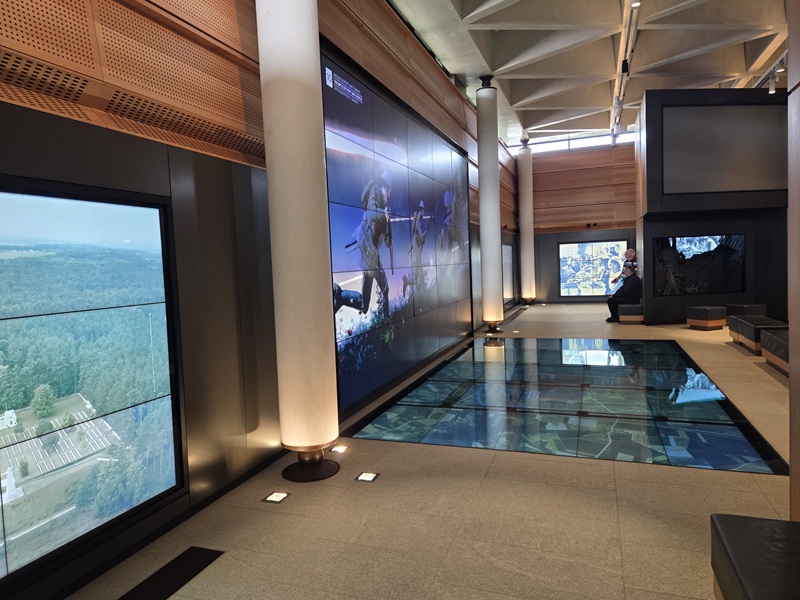
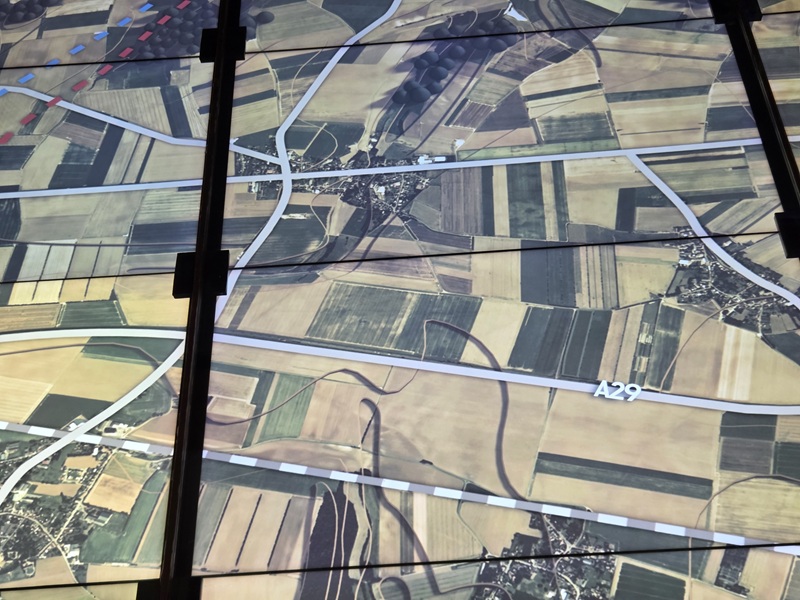
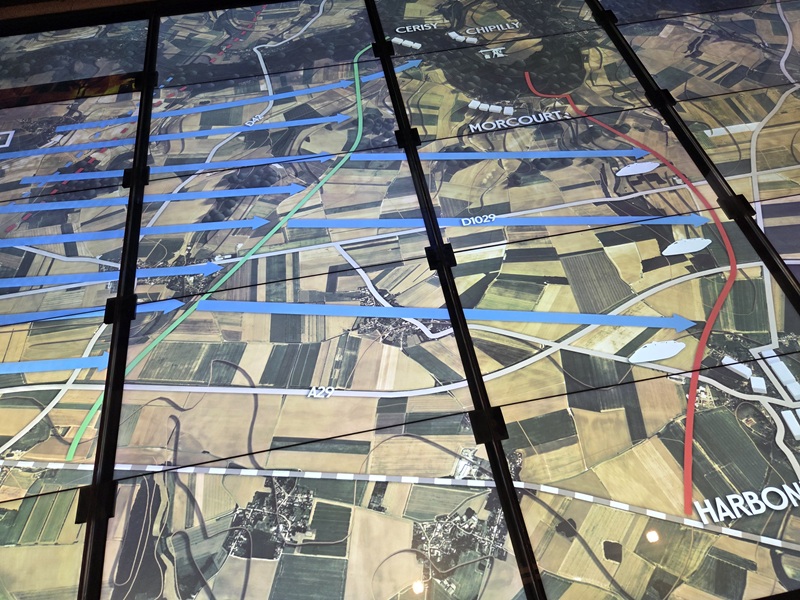
Leaving the museum & just up the road towards Le Hamel is the Australian Corps Memorial where it was inaugurated on the 22nd of July 1922 by King George VI and is the last memorial of the Great War to have been erected. On its walls are engraved the names of 10,729 Australian servicemen. Every year, on the 25th of April thousands of people gather on this site at dawn, to commemorate “ANZAC Day”.
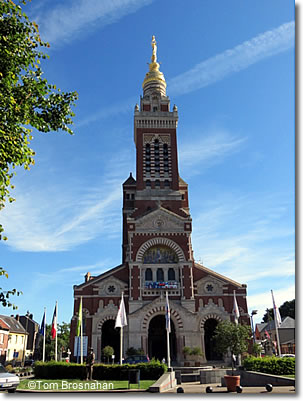
After a brief stop we venture down to Chipilly, Somme, Hauts-de-France where from “Camp Cesar viewpoint” you get a fantastic panoramic view of the valley of the Somme which gave its name to the famous “Battle of the Somme” in 1916. On our way to Albert (Albere) you can see for miles the Basilica Notre-Dame de Brebieres, which is of Neo-Byzantine style and was built at the end of the 19th Century. The original was completely destroyed by the Great War & was reconstructed identically by the son of the original architect: Edmond Duthoit. Its dome is covered with gold sheets & bares the statue of the Virgin Marie holding baby Jesus. The gold sheets with the sunlight on it glows like a strong beacon for miles.
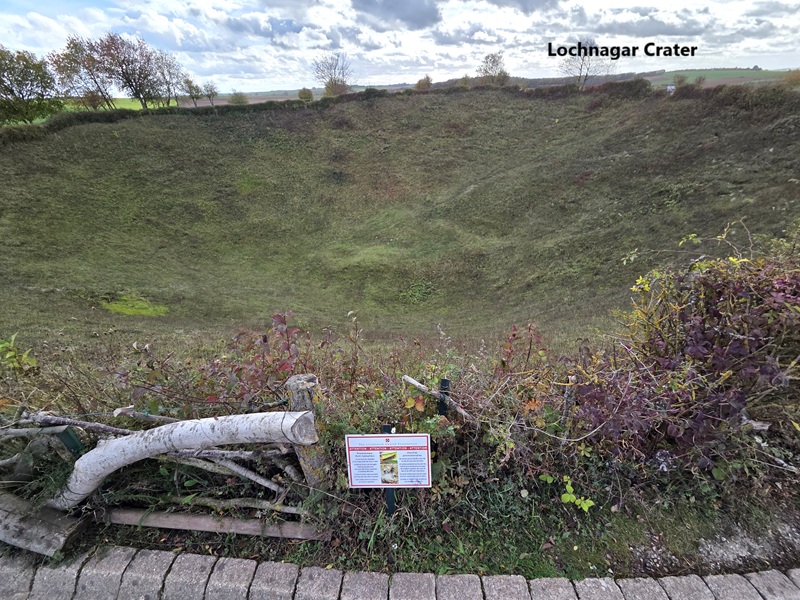
Our next stop is the Lochnagar Crater, on Route de la Grande Mine, 80300 Ovillers-la-Boisselle. It is on private property & there are controls in place to limit erosion. The owner has placed a large carpark for buses & cars to see the crater from the fence line. We are in the middle of the Somme offensive of 1916. This crater was one of 19 underground mines planned to explode under the German lines to assist the infantry advance at the start of the battle. This impressive site is 70 feet deep and 330 feet wide which makes it the largest crater in the Somme. The earth & dust was seen to rise over 1,000’ into the air, let alone the noise & vibration. Due to the stalemate in this sector it was discovered the Germans were building their own range of tunnels, but the British beat them with their timing. One tunnel set was found to be only 3m apart, so it was a wonder they couldn’t hear each other dig.
Following part of the Somme River we stop at the 1st Australian Division Memorial, 268 Route d Albert, 80300 Pozieres where the Australian official historian accompanying the troops, Charles Bean would say about Pozières that it “is more densely sown with Australian sacrifice than any other place on earth.” Pozieres sadly is well known to Australians where almost 7,000 men lost their lives here. We also pass by the Windmill Memorial at Pozières where an Australian memorial was established in the 1930s at the suggestion of Australia’s official war historian, Charles Bean. It commemorates the 23,000 casualties; some of which died in the surrounding countryside. Just opposite this site stands the “Tank Memorial” which gives an insight about the part played by the tanks on the Western Front.
Not far from here is the site where the Red Baron, Manfred von Richthofen crashed his plane & died in a dog fight in the sky while taking a reconnaissance flight over to the allied forces. Canadian planes were in the dog fight against other German planes but a few years ago experts disclaimed the Canadian pilot shot him down for it was an Australian machine gunner at his post did the duty. Out of respect (his plane was painted red also) The Red Barron was buried by the allies with military honours after a few days in a village some klms away. Bridgitt states his body has been exhumed 7times until his final resting place since. He died April 21, 1918, at 25yrs old just 4 days until the big push from the allies that ultimately won the war. Monash chose 25th April as the ultimate date for the push as a Gallipoli landing anniversary motivation I suspect.
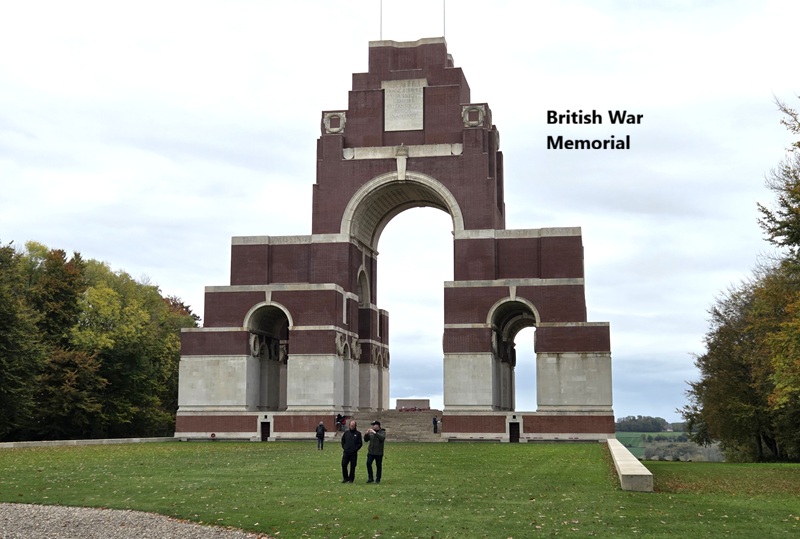
We later passed by Moquet Farm Pozieres where there were mass tragedies from 1st Australian, 2nd Australian & 4th Australian regiments doing the hard slog into battle. Everything was destroyed but we suffered huge losses. Circling back, we stopped at the Memorial de Thiepval, Rue de L’Ancre, 80300 Thiepval for the “Memorial of the Missing” where it is the largest British War Memorial in the world. This imposing monument overlooks the surrounding rolling countryside. On its walls are engraved the names of over 72,000 soldiers who are rather missing or whose bodies were found but not identified.
We then pass by the Ulster Memorial Tower & Thiepval Wood, Route de Saint-Pierre-Divion, 80300 Thiepval for Ulster Tower, Northern Ireland’s national war memorial. It was one of the first Memorials to be erected on the Western Front and commemorates the men of the 36th Division and all those from Ulster who served in the First World War. The memorial was officially opened on 19 November 1921. From the top of the hill, in the opposite field, you can still see the traces of the Battle of the Somme frontlines and the remains of a German machinegun post.
Getting late in the day 5pm this new parkland called The Memorial Terre-neuvien De Beaumont-hamel, Rue de l’Eglise, 80300 Beaumont-Hamel closes early now into Autumn by we are free to walk the grounds. This parkland is commonly called The Newfoundland Memorial Park which had money raised in Canada for 17 hectares bought & controlled by Canadian Newfoundlanders. It is the largest actual remaining battlefield site in the Somme and a memorial dedicated to all Newfoundlanders who served during the First World War.
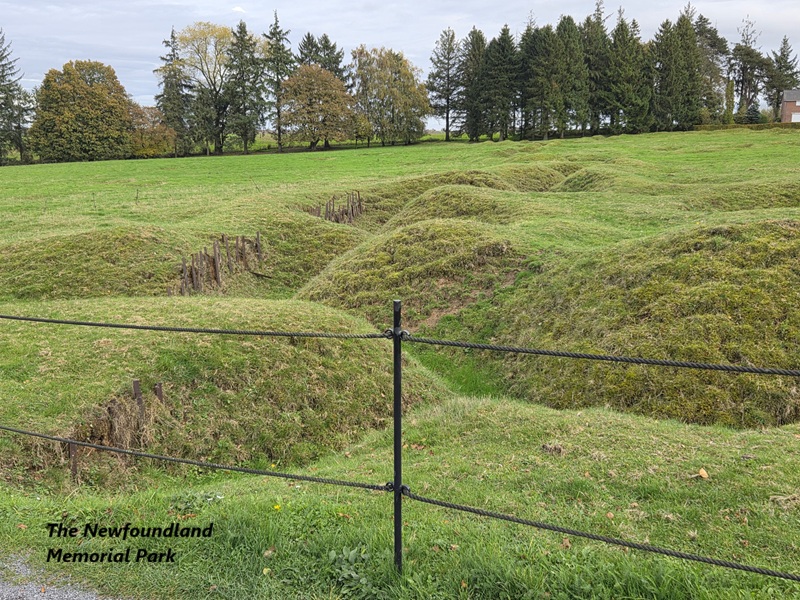
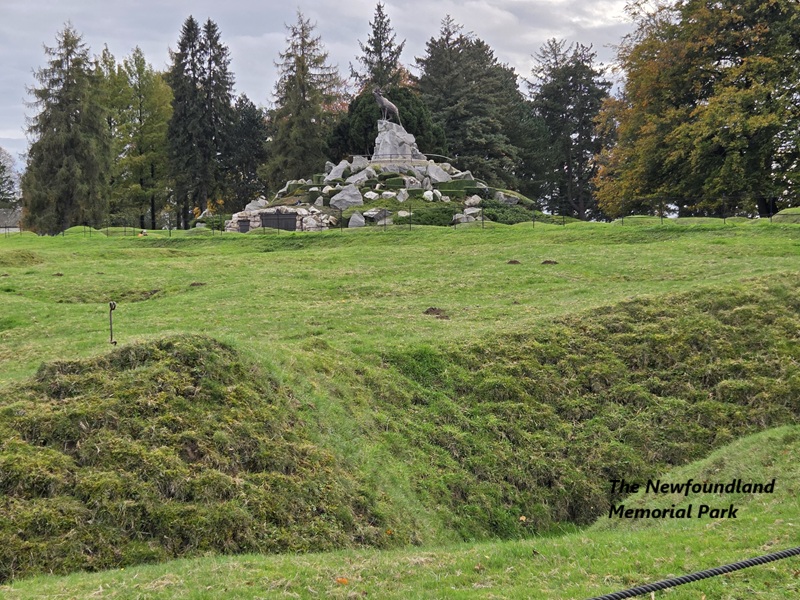
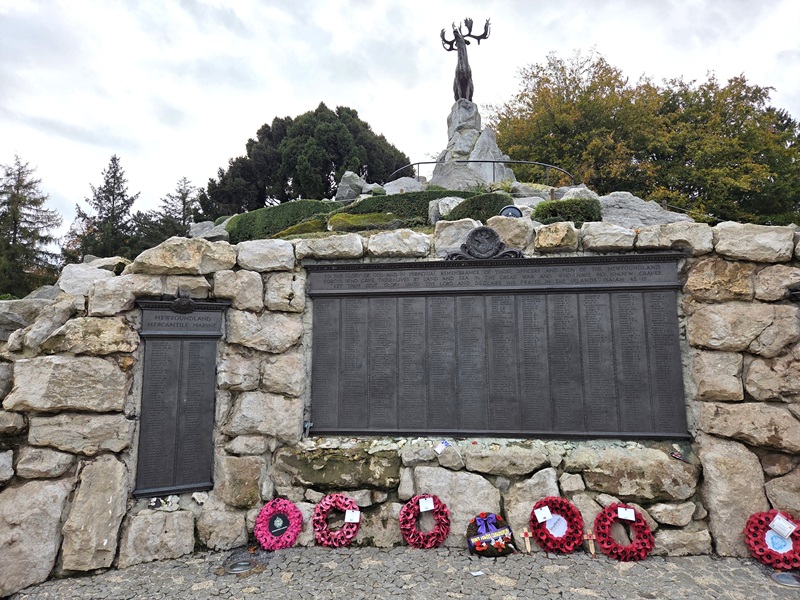
The Battle of the Somme was the first major engagement of the regiment where they suffered staggering losses on the 1st of July 1916. The ground, purchased in 1921 by the women of Newfoundland and their government has become the symbol of sacrifice and a source of identity of the island. Here you will find the routes of trenches, craters & the view looking down at the German line after pushing them back with huge losses & countless bravery. The Germans had the prime location to defend themselves. Brigitt refers back down to the creek we just crossed by car where it was found a huge underground bunker was created by the Germans (villagers said the Germans took 2 yrs to build). It starts near the creek bank & then several branches are formed & each branch has well equipped rooms for the commanders & other huge rooms for the soldiers, kitchen, dining, a medical centre, ammunition stores, etc, all underground. This tunnel system nears about 1klm long & goes even past the ridge of machine gun outposts that could see the Australians coming up the hill. The Australians were sitting ducks with no cover.
Just up the road we pull over to a carpark & Brigitt shows me where a house once stood. Totally obliterated, yet you can see in the crater the house footings but with concrete walls between them where the Germans had a tunnel system connecting each house or farmland house, totally out of view of the enemy.
Brigitt points to where her home is & further away her dad’s farm along these fighting lines. Her current home is just 3klms away, yet she has to take me 30mins down the road to Amiens for my drop off. I really felt for her driving all that way & then returning. I did find sufficient Euros to tip her which she was very hesitant to taking, but I won. She is a marvelous tour guide & the history & research she has done is staggering. I was so blessed to have her but couldn’t take too many photos or remember everything she stated, such was the type of tour we were doing. Far too much info but it was very well received. I’ll end my Blog #13 here. Many thanks for reading my blogs. My next blogs will be leaving Amiens for an overnight stay in Paris, then my hi-speed train trip to Barcelona Spain (6.5hrs) where I hope the sun is stronger. Please stay safe, happy & healthy. Cheers.
 BH Life Travels